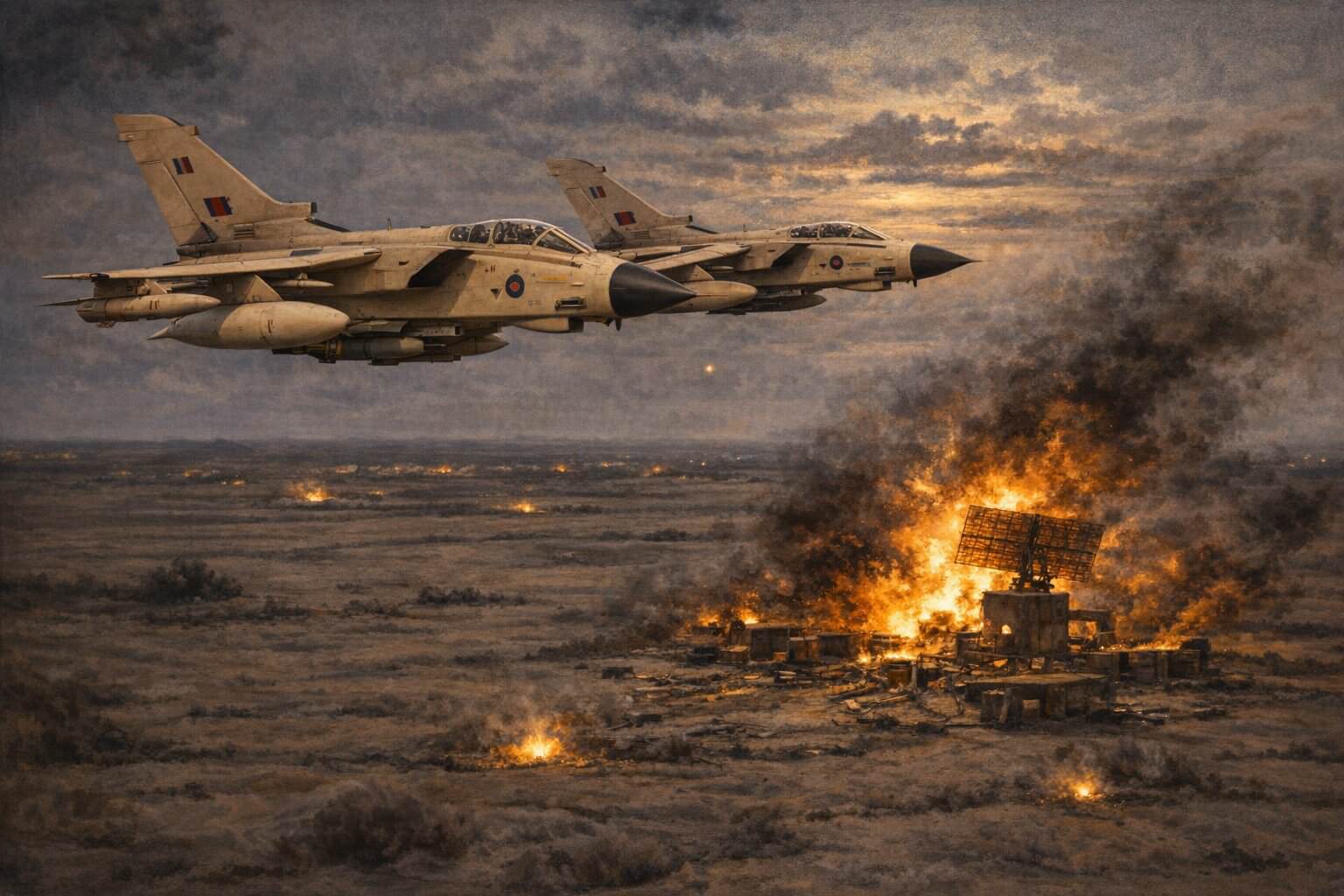
On 31 January 1999, two Royal Air Force Panavia Tornado aircraft carried out a precision strike against an Iraqi radar installation after Iraqi forces were assessed to have violated the southern no-fly zone. The attack formed part of ongoing coalition enforcement operations designed to contain Iraqi military activity following the 1991 Gulf War.
Since the end of Operation Desert Storm, coalition aircraft had patrolled designated no-fly zones over northern and southern Iraq. These zones were intended to prevent Iraqi aircraft operations and to deter the use of air power against civilian populations. Throughout the 1990s, coalition aircraft, including those of the RAF, regularly encountered Iraqi air defence systems that illuminated or attempted to engage patrolling aircraft with radar-guided surface-to-air missiles and anti-aircraft artillery.
Background to No-Fly Zone Enforcement
By 1999, enforcement of the southern no-fly zone had become a sustained operational commitment. RAF Tornado GR1 and later GR4 aircraft deployed to the Gulf region as part of Operation Bolton, the United Kingdom’s contribution to coalition air patrols. Missions involved combat air patrols, reconnaissance, and, when necessary, responses to hostile acts or threats.
Iraqi air defence networks remained active, particularly radar sites linked to surface-to-air missile systems. Coalition rules of engagement permitted action against air defence assets that posed a direct threat to patrolling aircraft. Such engagements were typically carried out using precision-guided munitions to minimise collateral damage.
The Strike of 31 January
On 31 January 1999, Iraqi radar activity associated with a southern air defence site was identified as hostile in nature. Following confirmation through coalition command channels, two RAF Tornados were tasked to strike the installation.
The aircraft employed laser-guided bombs, reflecting the standardisation of precision weapons in RAF service by the late 1990s. Targeting pods enabled accurate identification and designation of the radar site, allowing munitions to be delivered from medium altitude while maintaining reduced exposure to ground fire.
The attack successfully engaged the radar installation, degrading its capability to track and threaten coalition aircraft operating in the area. No RAF aircraft were lost during the operation, and the strike was assessed as effective in neutralising the immediate threat.
Operational Context
The action of 31 January was not an isolated incident but part of a pattern of intermittent engagements between coalition forces and Iraqi air defence units. Throughout the late 1990s, Iraqi forces frequently activated radar systems in an effort to challenge no-fly zone patrols. Coalition responses were calibrated to deter further hostile acts without escalating into broader conflict.
For the RAF, these missions required sustained readiness and coordination with allied air forces, particularly those of the United States. Aircraft operated from established Gulf bases under integrated command arrangements, reflecting the multinational character of enforcement operations.
The use of precision-guided munitions represented a significant evolution from earlier conflicts. Lessons learned during the Gulf War led to the widespread adoption of laser-guided bombs and advanced targeting systems, enhancing both accuracy and survivability.
Significance in the Wider Air Campaign
The strike on 31 January 1999 illustrates the continuing role of air power in post-conflict containment operations. While not part of a declared war in the conventional sense, enforcement of the no-fly zones involved real and recurrent risk. Coalition aircraft operated in contested airspace where hostile radar tracking and missile threats were routine.
For the RAF, such missions demonstrated the sustained operational commitments of the post-Cold War era. Air power was employed not only in large-scale conflicts but also in protracted enforcement and deterrence roles to uphold international agreements and protect civilian populations.
In the broader history of late-twentieth-century air operations, the engagement highlights the integration of precision-strike capabilities into routine operational practice. The ability to identify, designate, and neutralise specific threats with minimal collateral damage reflected the technological and doctrinal advances achieved since 1991.
The events of 31 January 1999 therefore stand as a representative example of the RAF’s continuing contribution to coalition air operations in the Gulf, underscoring the enduring relevance of precision air power in maintaining regional stability.