On This Day, 2020: On 13 October 2020, City of Elgin became the first Poseidon to land at RAF Lossiemouth, establishing the…
Read the entry →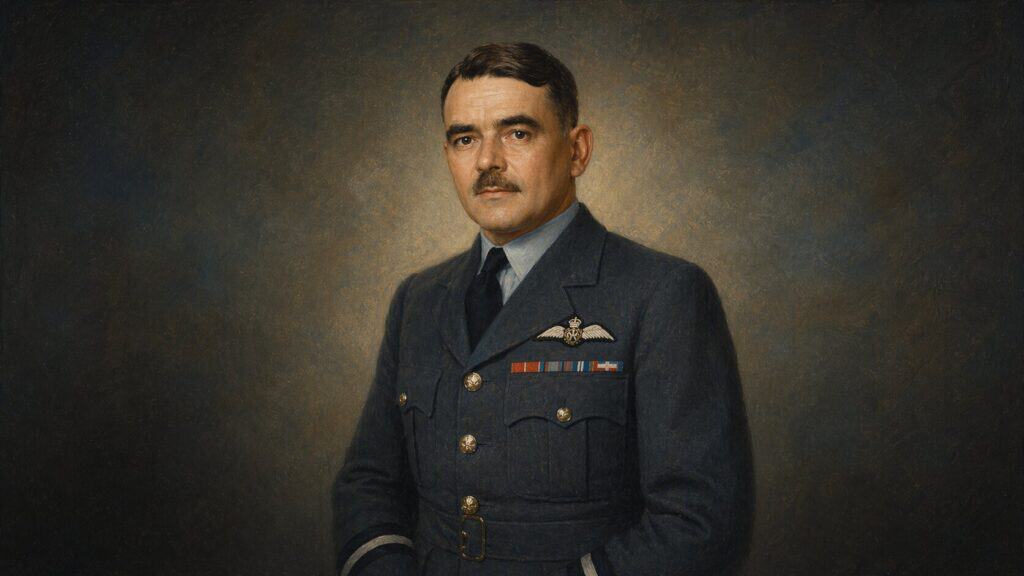
Air Commodore
Frank Whittle
Frank Whittle was the RAF officer and engineer whose turbojet work led to Britain’s first jet flight and reshaped military aviation.
Early Life
Frank Whittle was born in Coventry on 1 June 1907, the son of a skilled mechanic whose workshop gave him early exposure to tools, machinery and practical engineering. That mechanical upbringing mattered. It helped to form the combination of technical curiosity, persistence and self-belief that later defined his career. He was educated locally and entered the Royal Air Force as an apprentice while still young, joining a service that was itself only beginning to define its future role.
Whittle came into the RAF at a moment when air power was still closely tied to piston engines, modest speeds and the limits of interwar aircraft design. Even before his better-known engineering work, he showed unusual ability both as a practical technician and as a student. His advancement from apprentice to officer training was therefore significant in itself, and it set the course for the rest of his life.
Entry into Service
In 1923 Whittle entered the RAF as an aircraft apprentice at Cranwell. His technical promise led to a recommendation for officer training at the RAF College, Cranwell, where he trained as a pilot and officer cadet. He went solo quickly and developed a strong reputation as a gifted, if sometimes daring, flyer. During training he flew the Avro 504 and then the Bristol Fighter, while also demonstrating the intellectual range that would shape his later work.
At Cranwell he wrote a thesis on future aircraft design. Rather than accepting the continuing improvement of conventional propeller aircraft as the only practical path, he examined the possibility of very high-speed flight and the limits that piston engines and propellers would impose. From that line of thought came the early form of the idea that made his name: gas-turbine propulsion for aircraft.
Commissioned in 1928, Whittle joined 111 Squadron at Hornchurch, flying Armstrong Whitworth Siskin fighters. He was then posted within a year for instructional work and further professional development. His flying career remained important, but his broader historical significance increasingly lay in how he combined service experience with engineering ambition.
Operational Career
Whittle was not chiefly important as a combat leader or operational commander. His importance to RAF history rests instead on the way an RAF officer with flying experience identified a strategic technical problem and then tried to solve it from within the service. In 1930 he secured a patent for a turbojet concept. The idea was bold, but for several years it attracted limited official enthusiasm. The Air Ministry did not at once commit itself to the project, and progress depended on persistence, private backing and repeated technical proof rather than early institutional confidence.
He continued his professional development through engineering study, including advanced work at Cambridge, and combined that academic grounding with the practical experience of serving as an RAF officer. In 1936 Power Jets Ltd was formed to develop his engine. The first successful test run of a Whittle engine in 1937 marked a turning point. It did not end the difficulties of financing, design and official support, but it demonstrated that the concept could work in practice.
During the Second World War the value of that work became clearer. On 15 May 1941 the Gloster E.28/39, powered by a Whittle-designed engine, made the first British jet-powered flight. This was a decisive moment in British aviation history. It did not mean that jet aircraft would immediately replace existing RAF types, nor did it erase the long developmental work still required, but it established that Britain had entered the jet age.
Major Actions or Commands
Whittle's most important achievements were technical and institutional rather than command appointments in the usual RAF sense. Through Power Jets and his continuing RAF role, he became the central British figure in the practical development of turbojet propulsion. That position brought recognition, but it also brought strain. The development of the engine took place under intense wartime pressure, with uneven official support and frequent disputes over resources, control and direction.
His work fed directly into the emergence of British jet aircraft, above all the path that led from the experimental Gloster E.28/39 to the operational Gloster Meteor. In that respect Whittle's contribution was not a single dramatic act but a sustained effort to move a difficult idea from theory to tested reality. The process was demanding enough to affect his health seriously, and the pressures surrounding Power Jets and its later nationalisation left a lasting mark on him.
Whittle eventually retired from the RAF in 1948 with the rank of Air Commodore. By then his place in British aviation history was already secure, even if full official recognition had come more slowly than his achievement warranted.
Later Life and Death
After leaving the RAF, Whittle worked in technical and advisory roles in industry, including periods with BOAC, Shell and Bristol Aero Engines. In later life he moved to the United States and also served as a research professor at the United States Naval Academy. He remained a prominent public figure in discussions of aviation, engineering and invention, and his published reflections helped shape the historical understanding of early jet development.
Frank Whittle died in Columbia, Maryland, on 8 August 1996. His body was later buried at Cranwell, linking the close of his life to the place where his RAF career had begun.
Historical Significance
Frank Whittle remains one of the defining figures in the history of the Royal Air Force because he altered the technological basis on which modern air power would operate. His importance lies not simply in being associated with jet propulsion, but in helping to turn an idea that many regarded as impractical into a working British system under service conditions.
His legacy should still be viewed with balance. Jet propulsion was also being pursued elsewhere, most notably in Germany, and the move from concept to widespread military use depended on teams of engineers, manufacturers, pilots and officials as well as on Whittle himself. Even so, he stands as the principal British pioneer of the turbojet and one of the men most closely associated with the RAF's transition into the jet age. His career sits at the junction of invention, service life and the wider transformation of twentieth-century air warfare.
| Dates | Role | Unit | Aircraft |
|---|---|---|---|
| 1923-1926 | Aircraft apprentice | RAF Cranwell | |
| 1926-1928 | Officer cadet and pilot trainee | RAF College Cranwell | Avro 504; Bristol Fighter |
| 1928-1929 | Pilot Officer | 111 Squadron | Armstrong Whitworth Siskin III |
| 1929-1930 | Flying instructor course and instructional duties | Central Flying School, RAF Wittering | |
| 1936-1946 | Jet propulsion development work while serving RAF officer | Power Jets Ltd | |
| 1948 | Retired from Royal Air Force | Air Commodore |
Frank Whittle is remembered less for front-line command than for changing the technological foundations of air warfare. His reputation rests on making the turbojet a practical British reality under difficult institutional and wartime conditions, and on helping to open the path from experimental jet propulsion to operational RAF aircraft.
Frank Whittle Resigns from Power Jets
On 22 January 1946, Air Commodore Frank Whittle resigned from Power Jets after disputes over the…
22 January 2026 · 3 minMalta Fighters Mauled With 7 Hawker Hurricanes Lost
On 25 January 1942, RAF fighters on Malta suffered heavy losses when Luftwaffe Bf 109s shot…
25 January 2026 · 4 minRailway Offensive Opens with Bomber Command Strike
On 6 March 1944, Bomber Command struck the marshalling yards at Trappes, opening the Railway Offensive…
6 March 2026 · 3 min