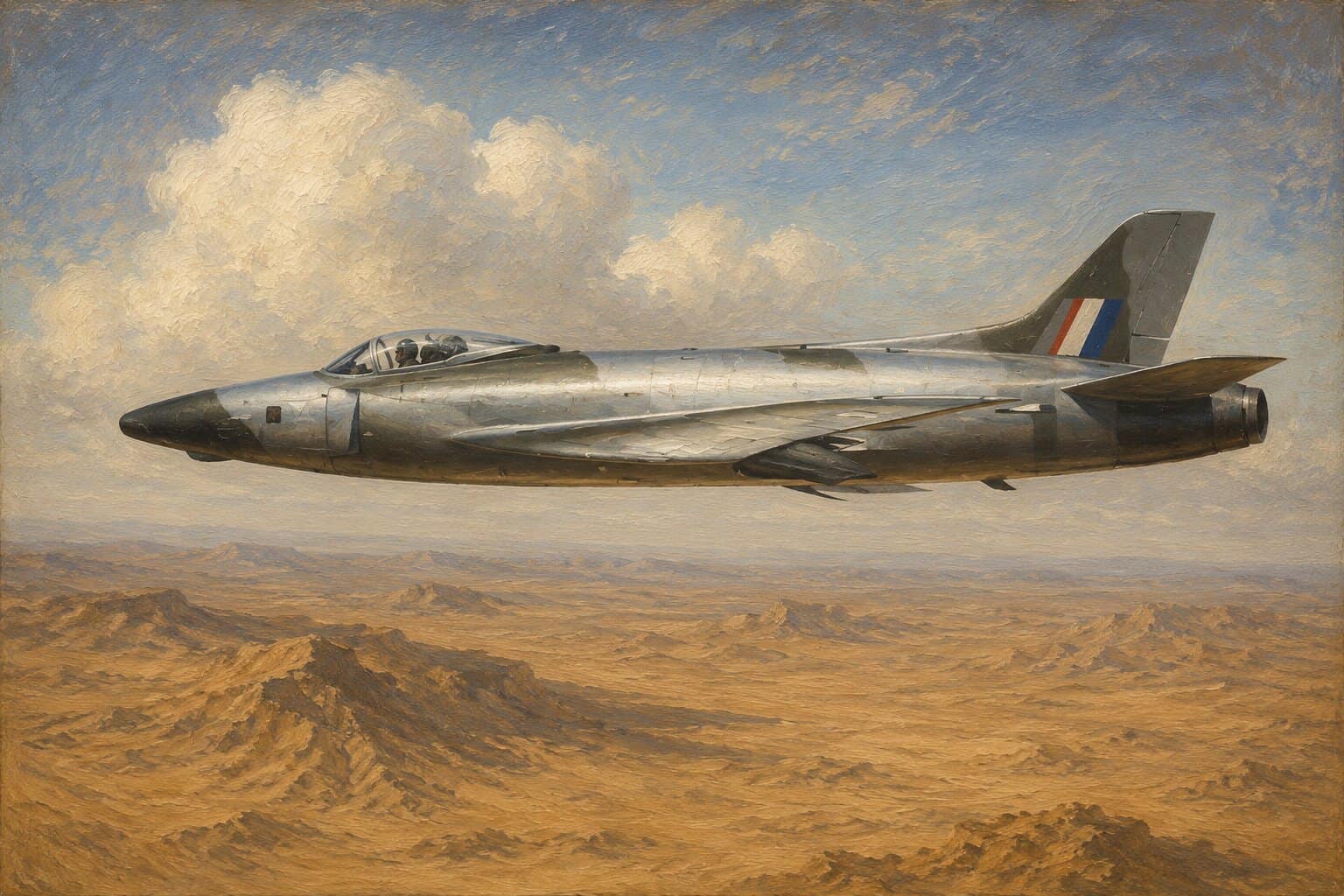
On 25 September 1953, Squadron Leader Michael Lithgow set a new world air speed record in a Supermarine Swift, averaging 737 mph over a measured 3-kilometre course at Tripoli. For Britain, the flight offered a striking demonstration of jet-age capability at a moment when aviation speed records still carried political and technological weight. Although the Swift would later acquire a mixed reputation in Royal Air Force service, this particular achievement briefly placed British aircraft design at the forefront of a highly visible Cold War contest.
A Record In The Jet Age
By the early 1950s, world air speed records had become more than technical milestones. They were public demonstrations of national competence in aerodynamics, propulsion and high-speed handling. In the first decade after the Second World War, such records were closely watched because they suggested how quickly military aircraft design was advancing. A successful record attempt could therefore serve both as an engineering triumph and as a statement of prestige.
Britain had been one of the pioneers of the jet age, yet by 1953, competition in military aviation had intensified. The United States and the Soviet Union were both associated with rapid progress in high-speed flight, while British manufacturers were under pressure to show that they remained capable of producing advanced combat aircraft. Against that background, a new world record by a British pilot in a British aircraft had significance beyond the measured course itself.
Lithgow And The Supermarine Swift
Michael Lithgow was a highly regarded test and record pilot, and the Swift provided the aircraft for Britain’s latest attempt on the record. Designed by Supermarine, the company long associated with the Spitfire, the Swift belonged to a new generation of swept-wing jet fighters intended for high performance in the early Cold War period. Its appearance and design reflected changing assumptions about speed, altitude and air combat in the age of turbojet power.
The record run at Tripoli required precise flying as well as raw performance. Averaging 737 mph over the course, Lithgow established a new official world mark and gave Britain a valuable headline in international aviation. The result suggested that British designers and pilots were still able to compete at the most demanding end of jet development, even as aircraft technology advanced at an exceptional pace.
Prestige And Reality
The record mattered because it linked technical progress with national standing. In the Cold War atmosphere of the early 1950s, aviation achievements were read as evidence of industrial capacity, research quality and military potential. A speed record did not prove that an aircraft was ideal in operational service, but it could demonstrate the strength of the engineering principles behind it and the skill of those testing it.
That distinction is important in the case of the Swift. The aircraft’s service career did not fully match the promise suggested by its record-breaking moment. In RAF use, it later developed a more complicated reputation, and it did not become the unqualified success that a world record might have implied to the public. Yet that does not diminish the value of the September 1953 achievement itself. The record remains a clear illustration of Britain’s ability to produce a machine capable of leading the world, if only briefly, in jet-era speed.
A Cold War On This Day
Seen in retrospect, Lithgow’s flight captures a revealing aspect of early Cold War aviation history. It was a moment when records, aircraft development and national prestige were closely intertwined, and when Britain still sought to define its place among the leading air powers of the jet age. The Swift’s later reputation complicates the story, but it also makes the event more instructive. On 25 September 1953, Britain achieved a genuine technical success, even if the aircraft behind it would later be judged more ambiguously in service.