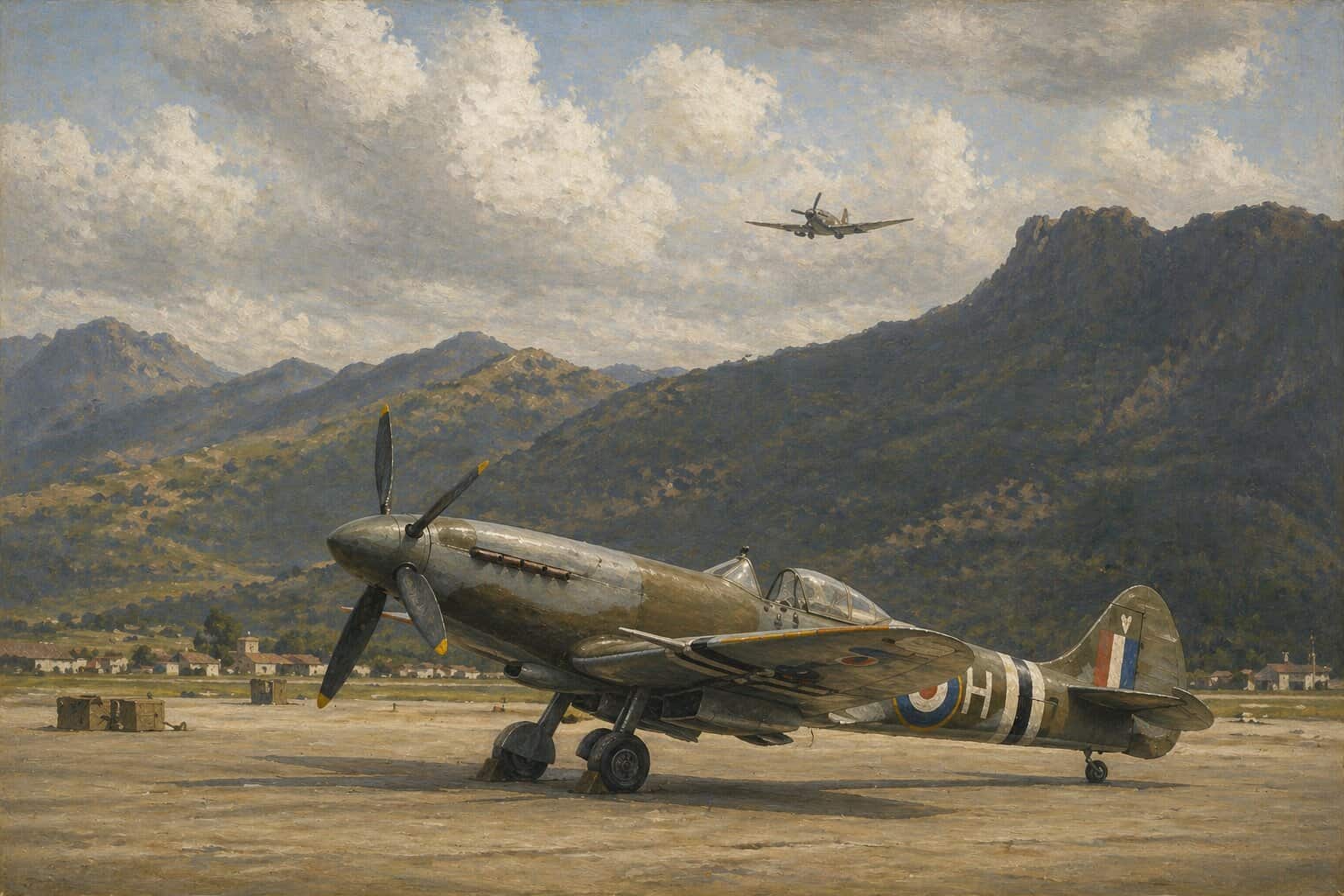
On 11 May 1949, 28 Squadron deployed from Malaya to strengthen the air defences of Hong Kong. The move took place against the unsettled background of the Chinese Civil War and reflected the continuing strategic importance of the colony in the early post-war Far East.
Although this was not a dramatic wartime battle in the conventional sense, it was an important example of how the RAF continued to use air power as a visible instrument of imperial defence, deterrence and reassurance after the Second World War. In that respect, the deployment forms part of the wider story of Britain’s attempt to maintain stability at key overseas positions amid rapidly changing political conditions.
Reinforcing a Strategic Outpost
Hong Kong occupied a sensitive position in 1949. The course of the civil war in China created uncertainty across the region, and British authorities had reason to consider the vulnerability of the colony’s air defences. The dispatch of fighter aircraft carried political as well as military significance.
The unit involved was 28 Squadron, which moved from Malaya with Supermarine Spitfire fighters. The aircraft were not sent merely as a token force. Their presence was intended to strengthen local air defence and to demonstrate that Britain remained prepared to protect an important base at a moment of regional instability.
In RAF terms, this was a reminder that the end of the war in 1945 had not reduced the service to a purely European or peacetime footing. The RAF still had to cover global commitments, often in circumstances shaped less by declared war than by tension, uncertainty and the need for rapid movement between overseas stations.
The RAF in the Early Cold War World
The deployment to Hong Kong belongs to the transitional period between the end of the Second World War and the clearer strategic alignments of the Cold War. During these years, the RAF continued to perform a wide range of imperial and regional tasks, including deterrent presence, air defence and support to British interests overseas.
That made mobility especially important. The ability to shift aircraft and squadrons from one station to another remained a practical expression of British power, even when no immediate combat followed. In this case, sending Spitfires from Malaya to Hong Kong showed how the RAF could still respond quickly to political developments in Asia.
The use of the Supermarine Spitfire is also historically notable. By 1949, the aircraft had already become part of the established legend of the Second World War, yet it remained in front-line service in some overseas roles. Its appearance in the defence of Hong Kong linked the wartime RAF to the demands of the post-war world.
Cold War Significance
The reinforcement of Hong Kong on 11 May 1949 illustrates a less familiar side of RAF history. Not every significant movement involved a famous battle or major campaign. Some moments mattered because they showed the RAF adapting to the strategic anxieties of a changing world while still relying on proven aircraft and experienced squadrons.
On this day, the dispatch of 28 Squadron’s Spitfires underlined both the continuing reach of the RAF and the geopolitical importance of Hong Kong at the close of the 1940s. It stands as a reminder that British air power in the post-war era was shaped not only by memories of recent victory, but by new uncertainties emerging across Asia.