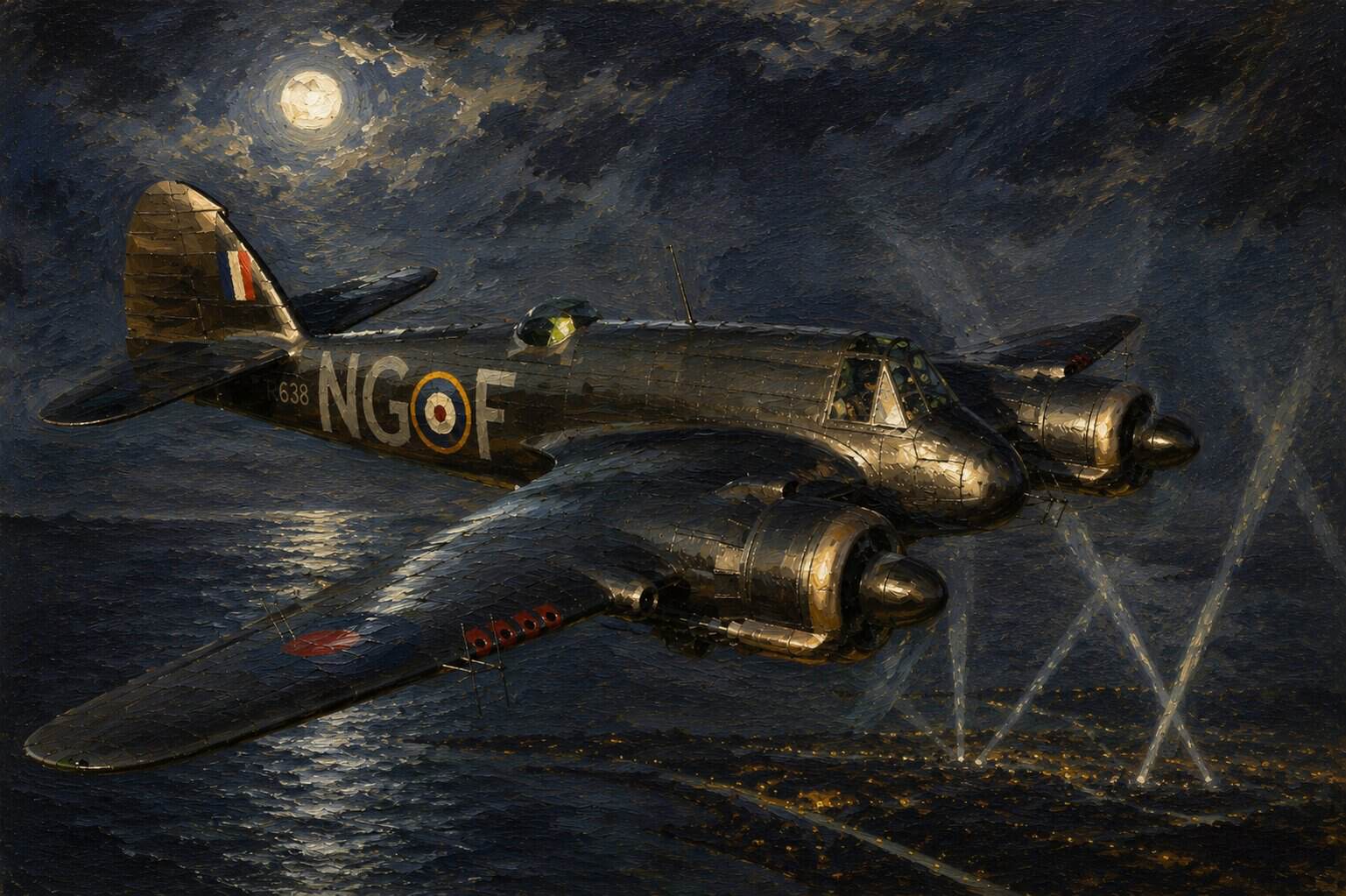
On the night of 19 November 1940, Flight Lieutenant John Cunningham and Sergeant John Phillipson of No. 604 Squadron intercepted a Junkers Ju 88A-5 in a radar-equipped Bristol Beaufighter. Their attack damaged the German bomber, which subsequently crashed near East Wittering, close to Chichester. The engagement gave the squadron its first airborne-interception radar-assisted victory and marked the first German bomber brought down by a Beaufighter night fighter of RAF Fighter Command.
The success came during the Blitz, as the RAF worked to build an effective defence against bombing after dark. Cunningham flew the aircraft, while Phillipson served as its radar operator and observer. Their achievement depended on the combination of aircraft performance, electronic equipment and close crew co-operation.
Finding the bombers at night
The Luftwaffe’s night offensive placed a different set of demands on Britain’s air defences. Detecting an approaching raid and bringing a fighter close enough to attack were separate tasks. Darkness restricted visual observation and made the final approach to an individual bomber particularly difficult.
Ground radar and fighter control provided the wider picture needed to direct defending aircraft towards an interception. Airborne-interception equipment carried the search into the fighter itself. Together, these elements offered a means of narrowing the distance between a defending crew and an enemy aircraft until visual contact and an attack became possible.
The development of RAF night-fighter radar, tactics and crew co-operation therefore involved an entire system. Controllers, aircrew and the equipment they used each contributed to the attempt to locate bombers in darkness. The engagement of 19 November demonstrated the operational value of bringing those elements together.
The Beaufighter and its two-man crew
The Bristol Beaufighter gave Fighter Command a capable platform for this developing role. Its twin-engined configuration combined speed and endurance with heavy armament and room for airborne radar equipment. These qualities helped the crew turn an interception opportunity into an effective attack.
AI Mk IV radar was central to the aircraft’s night-fighting work. Its information had to be interpreted by the radar operator and communicated to the pilot, who manoeuvred the fighter towards the target. The practical effectiveness of the installation rested on the men’s ability to work together under operational conditions.
For Cunningham and Phillipson, the division of responsibilities placed both crew members at the centre of the action. The pilot controlled the approach and attack; the observer’s radar work helped make the encounter possible. Their success gave No. 604 Squadron direct experience of the system’s combat potential.
The interception and its outcome
The bomber encountered that night was a Ju 88A-5 of 3./Kampfgeschwader 54. Cunningham and Phillipson damaged the bomber during the interception. It subsequently came down near East Wittering on the Sussex coast.
Two members of the German crew were killed. The other two baled out and were captured. The bomber’s loss turned the Beaufighter engagement into a confirmed success at a time when effective night interceptions remained difficult to achieve.
Building an effective night defence
The victory was an early milestone in the Beaufighter’s service with Fighter Command. It demonstrated the aircraft’s growing effectiveness in the night-fighter role and gave No. 604 Squadron its first AI-assisted success. Cunningham would subsequently become one of the RAF’s leading night-fighter pilots.
The wider task of defending Britain during the Blitz continued. Its progress depended on improving the connections between detection, control, airborne radar and the final attack. The events of 19 November supplied a concrete example of that developing method: a trained two-man crew, using radar in a suitably armed fighter, had intercepted and fatally damaged an enemy bomber in darkness.
