
The Norwegian campaign of 1940 exposed the limits of British air power at the very moment when air power was becoming central to modern war. On paper, the Royal Air Force possessed bombers for strike work, flying boats and patrol aircraft for reconnaissance, and fighters that had already shown their promise in home defence. In practice, Norway offered almost none of the conditions needed to bring those strengths together. Distances were long, airfields were few, weather was unreliable, and every major Allied move depended on sea transport and hurried improvisation. The Luftwaffe, by contrast, gained the advantage that mattered most: usable bases close to the fighting.
For the RAF, Norway became a campaign of effort without decisive leverage. Reconnaissance was often brave and useful, bomber operations were persistent, and the men sent ashore with Gladiators and Hurricanes showed great determination in conditions that bordered on the primitive. Yet the central fact remained unchanged for most of the campaign. Air power could not be applied effectively from Britain alone against an enemy already established in southern Norway and operating under far more favourable geographical conditions. Only in the north, once Bardufoss had been made into a workable fighter base, did the RAF begin to show what properly based local air support might achieve. By then, however, the wider strategic situation had moved on.
Norway was therefore more than an unsuccessful expedition. It was an early warning. It showed that modern operations could collapse if airfields, warning systems, ground organisation and inter-service planning were treated as secondary matters. It also showed that courage and effort could not overcome air geography. In Norway, the RAF learned that lesson the hard way.
Why Norway Mattered Before The Shooting Started
Norway mattered to Britain before the first German troops came ashore because the country lay across vital sea routes and beside one of the most important economic arteries feeding the German war effort. Swedish iron ore reached Germany in large quantities through Narvik during the winter months, and British planners had long considered ways to interrupt that flow. At the same time, Norway’s long coastline offered naval and air positions of obvious strategic value in the North Sea and the northern approaches. A German hold over Norwegian ports would threaten British shipping, extend the range of enemy reconnaissance and bomber forces, and complicate the defence of the Home Fleet.
Yet British policy before April 1940 was marked by hesitation. Economic pressure, diplomacy, mining schemes and contingency planning all existed, but they did not amount to a settled operational design. Norway was recognised as important, though not with the urgency required to properly prepare the means of intervention. That gap between strategic interest and operational readiness would shape everything that followed.
For the RAF, pre-war and early-war planning had not produced a mature system for sustained campaigning in Norway. The country offered little in the way of developed air infrastructure, especially for the kind of rapid expeditionary support an Anglo-French landing would require. Roads, rail links and communications were sparse. Terrain divided one region from another. Weather could ground aircraft or scatter formations with little warning. Even if troops were landed successfully, their air cover would depend on either long flights from Britain or on the rapid creation of forward bases in a country whose geography worked against haste.
That mattered because the opening question in Norway was not simply how many aircraft Britain could send. It was whether those aircraft could be sustained, serviced, directed and protected close enough to the battlefield to influence events. When Germany invaded on 9 April 1940, the answer was still uncertain. The campaign would show how dangerous that uncertainty really was.
The Opening Blows From Long Range
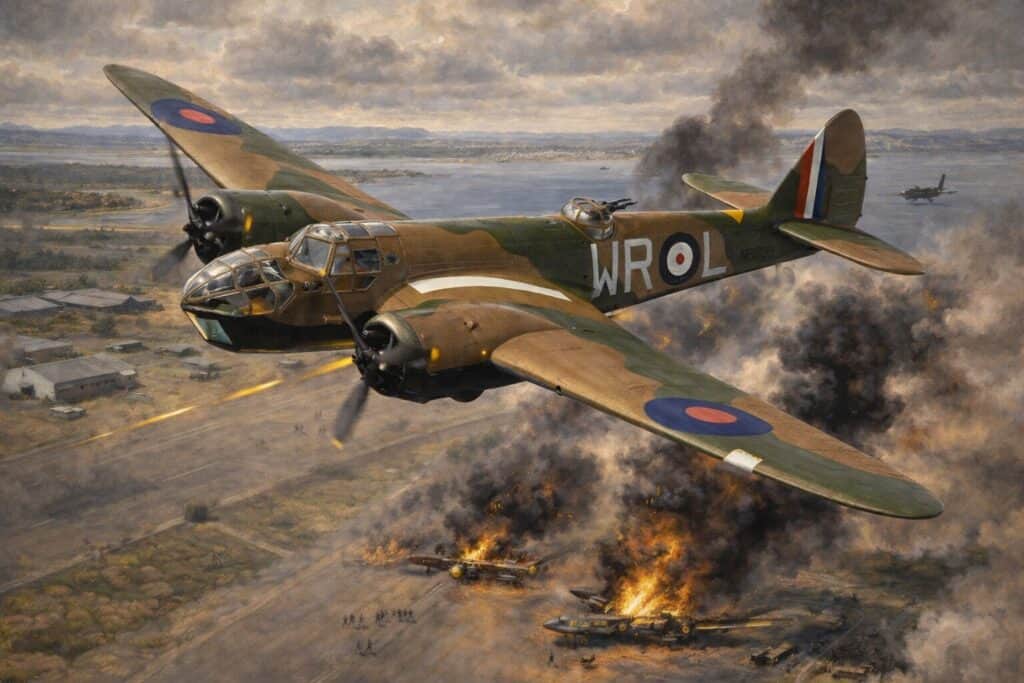
The first phase of the campaign placed the RAF in the role it could fulfil most readily from home bases: reconnaissance, maritime strike and bombing against ports, airfields and shipping. Even before the full scale of the German assault became clear, RAF and Coastal Command aircraft were searching the North Sea and Norwegian approaches for signs of a large enemy movement. These patrols were arduous and often conducted in poor visibility. Mist, rain and broken clouds repeatedly complicated sightings, navigation and reporting. Even so, the reconnaissance effort helped establish that major German naval forces were at sea and moving towards Norway.
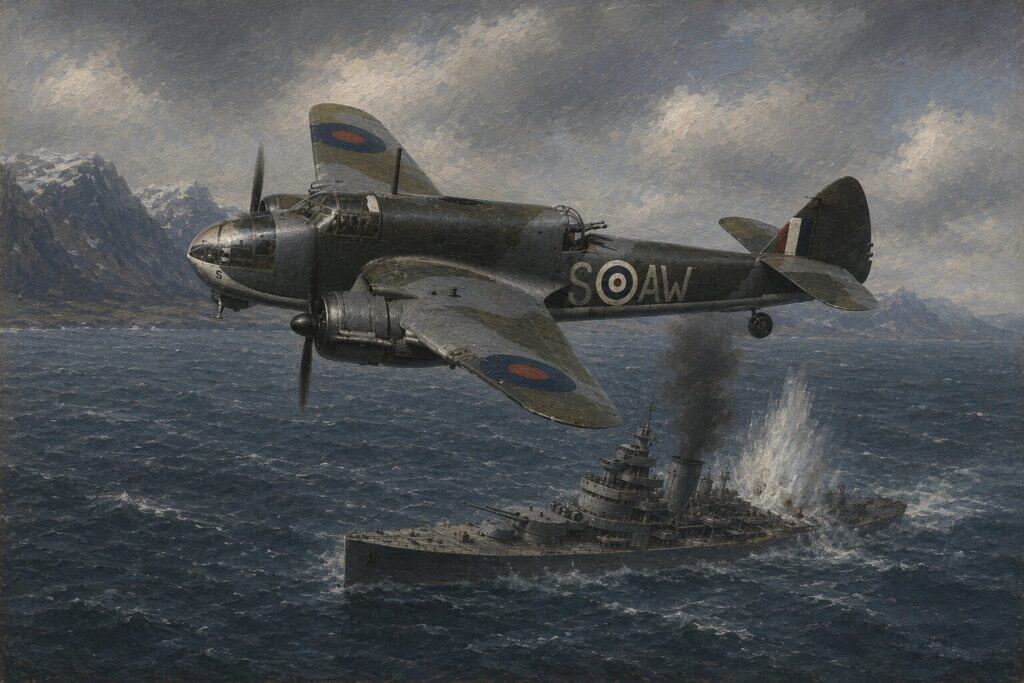
Once the invasion began, the RAF struck where it could. Bristol Blenheims attacked German warships. Coastal Command aircraft shadowed shipping and reported on enemy concentrations at ports such as Bergen, Kristiansand and Trondheim. Bomber Command mounted attacks against captured airfields, most notably Stavanger-Sola, which lay within the least punishing range from British bases and quickly became a recurring target. Wellingtons, Whitleys and Hampdens were committed as the campaign broadened.
There was determination in these operations, but the results were necessarily limited. Targets were distant, the weather was often poor, and enemy positions were difficult to locate and strike accurately. The RAF could inconvenience, harass and occasionally disrupt; it could not impose control. The sinking of the cruiser Königsberg by Fleet Air Arm Skuas at Bergen became one of the most celebrated early successes of the campaign, but even that episode illustrated the larger pattern. British air action could hurt the Germans, especially when reconnaissance, naval intelligence and favourable opportunity came together, yet such moments did not alter the underlying operational balance.
The Luftwaffe’s own advantage was becoming clearer by the day. German forces quickly secured airfields in southern Norway and could also operate from bases in Denmark. That reduced transit times, increased sortie rates and allowed far tighter links between air action and the movement of troops and ships. The RAF, operating largely from Britain, was spending much of its effort merely getting to the battlefield. Aircraft arrived with less time over target, less margin for error and fewer options if weather closed in or damage forced an early return.
This was the central distortion of the Norwegian campaign. The RAF was active from the start, but activity and influence were not the same thing. Long-range bombing and reconnaissance could not compensate for the absence of secure local fighter and strike basing. As the battle moved inland and Allied troops attempted to recover the initiative around Trondheim and in central Norway, that truth became harder to ignore.
Central Norway And The Problem Of Air Geometry
The Allied attempt to challenge German control in central Norway was hampered by a form of strategic geometry that consistently favoured the enemy. British and French troops landed at Namsos and Åndalsnes with the aim of threatening Trondheim from north and south rather than storming it directly. On paper, the approach offered a way to recover a crucial objective. In practice, the operation depended on vulnerable ports, exposed roads and shipping lanes, and troop movements conducted under hostile air superiority.
RAF bombers continued to attack the airfields from which German power flowed into the theatre, especially Stavanger-Sola. These efforts were not futile. They forced German dispersal, imposed caution and added friction to enemy operations. But they did not close the airfields, nor did they remove the pressure on Allied troops and shipping. The Luftwaffe retained the ability to strike quays, roads, railways and concentrations of men and matériel faster than the Allies could repair, unload or reorganise them.
The question of fighter protection was even more severe. Namsos lay beyond practical and sustained fighter cover from Britain. Åndalsnes was somewhat less distant, but even there the margin was thin and the duration of protection limited. Carrier aircraft could help, but naval aviation could not substitute indefinitely for a land-based air system. The result was that the Allied ground effort advanced under conditions in which German aircraft could attack with a freedom that British commanders found difficult to counter.
In such circumstances, air superiority was not an abstract concept. It meant bombed quays, broken communications, delayed landings, harassed road columns and a constant drain on confidence. It also meant that every Allied administrative weakness became more dangerous. A congested harbour, a shortage of vehicles, a poorly prepared dispersal area or a gap in anti-aircraft protection might have been inconvenient in a quieter theatre. In Norway, under enemy air pressure, such weaknesses became operational liabilities.
The RAF’s bombers were therefore being asked to do more than bombers could reasonably do. They were expected not merely to attack enemy bases and shipping, but to offset the consequences of an Allied force operating without a secure local air umbrella. That was beyond their power. Bombing from Britain could trouble the Germans and achieve occasional local effects, yet it could not create the day-to-day control that troops and ships required in central Norway.
This phase of the campaign revealed a lesson that would recur throughout the war: the effectiveness of air power depended not only on aircraft and crews but on position, support and timing. In central Norway, the RAF was not absent. It was mis-situated. That distinction mattered because it explained why so much effort yielded so little operational freedom.
Lesjaskog And The Failure Of Improvised Fighter Support
The most vivid RAF attempt to change the balance in central Norway came with the deployment of No. 263 Squadron and its Gloster Gladiators. The idea was bold and understandable. If fighters could be established on Norwegian soil, Allied troops and bases might at last receive some direct protection. Yet the episode at Lesjaskog showed how badly a fighter force could suffer when sent forward without the ground system needed to sustain it.
No. 263 Squadron flew into a makeshift landing ground on a frozen lake at Lesjaskog in late April. The very choice of site spoke to the urgency of the situation. There had been no time to build a proper airfield, create deep dispersal arrangements, establish a reliable warning network or accumulate the vehicles, tools and servicing equipment that a fighter squadron required. In theory, the Gladiators brought the promise of immediate protection. In reality, they arrived in conditions that left them acutely vulnerable before they had even settled into operations.
German bombers struck quickly. Aircraft on the ground were exposed, servicing arrangements were strained, and the detachment lacked the resilience needed to absorb repeated attack. The weaknesses were structural rather than personal. Pilots and ground crews worked hard under pressure, but a fighter squadron cannot fight effectively if refuelling, repair, dispersal and warning all depend on hurried expedients. Losses mounted on the ground, precisely where fighters are least able to defend themselves. The detachment then shifted to Setnesmoen, but the move did not solve the deeper problem. Without the broader system of support and protection, the squadron could not transform the campaign.
The Lesjaskog experience has sometimes been remembered simply as a tale of misfortune, but it was more than that. It exposed a false assumption at the heart of the Allied approach to Norway: that fighters could be inserted into a contested theatre as if aircraft alone constituted air support. In fact, fighter power was an organised network. It required landing grounds fit for purpose, proper concealment and dispersal, fuel and ammunition under cover, maintenance capacity, communications, warning arrangements and some degree of local security. Without those elements, even the arrival of fighters could add to the confusion rather than relieve it.
The failure also carried a wider moral effect. It deepened British recognition that central Norway could not be held or developed in the face of German air superiority. Ports such as Namsos and Åndalsnes remained under relentless pressure. Evacuation became unavoidable. The RAF had not been idle, but the campaign had shown how thin the line was between intervention and improvisation. At Lesjaskog, that line gave way.
Bardufoss, Narvik And A Glimpse Of What Might Have Been
Northern Norway offered a different set of conditions, and for that reason, it produced the most instructive RAF success of the campaign. The struggle for Narvik was still difficult, still exposed to weather and still dependent on sea power, but it was farther from the main Luftwaffe base system in the south. That distance did not remove the German threat, yet it reduced the density and persistence of enemy air action. If the Allies could build a functioning fighter base in the north, the RAF would finally have a chance to operate on less punishing terms.
That possibility rested on Bardufoss. Creating the base was itself an achievement. It required engineers, airmen, naval support, Norwegian cooperation and local labour to turn an austere site into something usable under wartime pressure. Just as importantly, the work was informed by Lesjaskog’s memory. Dispersal, protection and practical organisation were treated not as luxuries but as conditions of survival. Bardufoss did not become a perfect station; Norway allowed no such thing. It became, however, a real operating base rather than a desperate expedient.
No. 263 Squadron returned to the theatre after re-equipping, and No. 46 Squadron arrived with Hawker Hurricanes. Even then, the environment remained exacting. Flying in mountain weather demanded judgment and luck. Visibility could collapse without warning. Communications and reporting were far from ideal. Surfaces at forward strips could prove too soft for reliable use, as experience elsewhere soon confirmed. Yet from Bardufoss, the RAF at last possessed something it had lacked through most of the campaign: fighters based where they could influence the battle directly.
That change was immediately significant. Local fighter patrols provided cover for Allied troops, shipping, and the Narvik area itself. German aircraft no longer operated against the northern lodgement with the same ease they had enjoyed over central Norway. The RAF did not achieve complete mastery of the air, but it imposed a cost and restored a measure of balance. In practical terms, that meant more freedom for Allied movement and a greater chance of protecting anchorages and assembly areas at crucial moments.
The final assault on Narvik demonstrated the value of even modest local air strength. Fighter patrols supported the operation, and when the weather temporarily interfered, the vulnerability of the Allied force became obvious at once. Once the patrol system was resumed, RAF fighters again helped to limit German interference. Narvik was captured on 28 May. For a brief moment, the campaign seemed to show that with a workable base and coherent organisation, the RAF could indeed shape events in Norway.
Yet the achievement came too late to rescue the wider venture. By the time northern operations reached maturity, the German offensive in the west had transformed British priorities. France and the defence of the United Kingdom now outweighed every northern ambition. Narvik could be taken, its facilities damaged, and the force withdrawn; it could not serve as the starting point for a broader revival of Allied strategy in Scandinavia.
There was, nonetheless, a hard and valuable lesson in the northern success. The RAF had not suddenly become stronger than it had been in central Norway. What changed was the relationship between aircraft and base. Bardufoss showed that once fighters were properly placed and supported, they could make their presence felt even in a harsh and difficult theatre. The difference between failure and partial success was not spirit. It was infrastructure, geography and time.

Withdrawal, The Loss Of Glorious, And The Campaign’s Meaning
The withdrawal from northern Norway under Operation Alphabet closed the campaign in a manner that was both efficient and sombre. The RAF’s fighters remained active in covering the evacuation, and in the last days, they performed some of their most useful work. Sorties were flown against renewed German air pressure, and the combination of weather, local patrols and carrier support reduced the enemy’s ability to strike the retiring force freely. Even in retreat, the value of locally based fighter cover was plain.
Then came one of the most dramatic episodes of the campaign: the recovery of RAF Hurricanes aboard HMS Glorious. The aircraft of No. 46 Squadron had not been designed for carrier landing, and the original expectation had been that they might have to be destroyed rather than withdrawn. Instead, through a notable piece of improvisation and airmanship, Hurricanes were landed on the carrier and saved, at least for the moment. The effort captured something characteristic of the entire Norwegian operation: ingenuity and courage applied in response to strategic and logistical difficulty.
The next day, Glorious and her destroyer escorts were sunk by the German battlecruisers Scharnhorst and Gneisenau. With the carrier went many of the men and aircraft who had fought so hard in Norway. The loss cast a tragic shadow over a campaign already associated with disappointment and withdrawal.
In strategic terms, Norway was a British defeat, and for the RAF, it was a campaign of frustrated potential. Bomber Command had not been able to suppress the enemy’s air bases or decisively sever German communications. Coastal Command had provided important reconnaissance, but reconnaissance alone could not reverse events. Fighter deployments, where badly improvised, proved highly vulnerable; where properly based, they proved useful but arrived too late to alter the larger decision.
Even so, the significance of Norway should not be measured solely by immediate success or failure. The campaign exposed truths that Britain could not afford to ignore in the months that followed. It showed that air superiority rested on more than the number of aircraft available on paper. It depended on warning, communications, servicing, dispersal and the possession of airfields close enough to matter. It showed that expeditionary warfare under enemy air attack required an intimacy between naval, air and ground planning that Britain had not yet mastered. It showed, too, that terrain and weather were not background details but operational forces in their own right.
Those were not trivial lessons in the spring of 1940. Within weeks, Britain would face a far more direct and dangerous test. The experience of Norway did not provide simple answers, but it did sharpen an understanding that would matter in home defence and in later overseas campaigns alike. Air power could be decisive, but only when the system supporting it was as carefully prepared as the aircraft at its front end.
Conclusion
The RAF’s campaign in Norway was shaped less by lack of effort than by the conditions under which that effort had to be made. Britain tried to fight for Norway from too far away, with too little prepared basing, in a theatre where weather, terrain and communications worked constantly against rapid correction. German control of southern airfields gave the Luftwaffe the operational advantage that mattered most, and the Allies never overcame it in central Norway.
Only in the north, once Bardufoss had been built into a viable fighter base, did the RAF begin to demonstrate what local air support might achieve. That success was real, but limited by time and overtaken by events in France. Norway stands as an early-war lesson in the practical foundations of air power. Aircraft, crews and courage were indispensable, but without position, infrastructure and coherent planning, they could not secure the field. In 1940, the Norwegian mountains and fjords made that truth brutally clear.