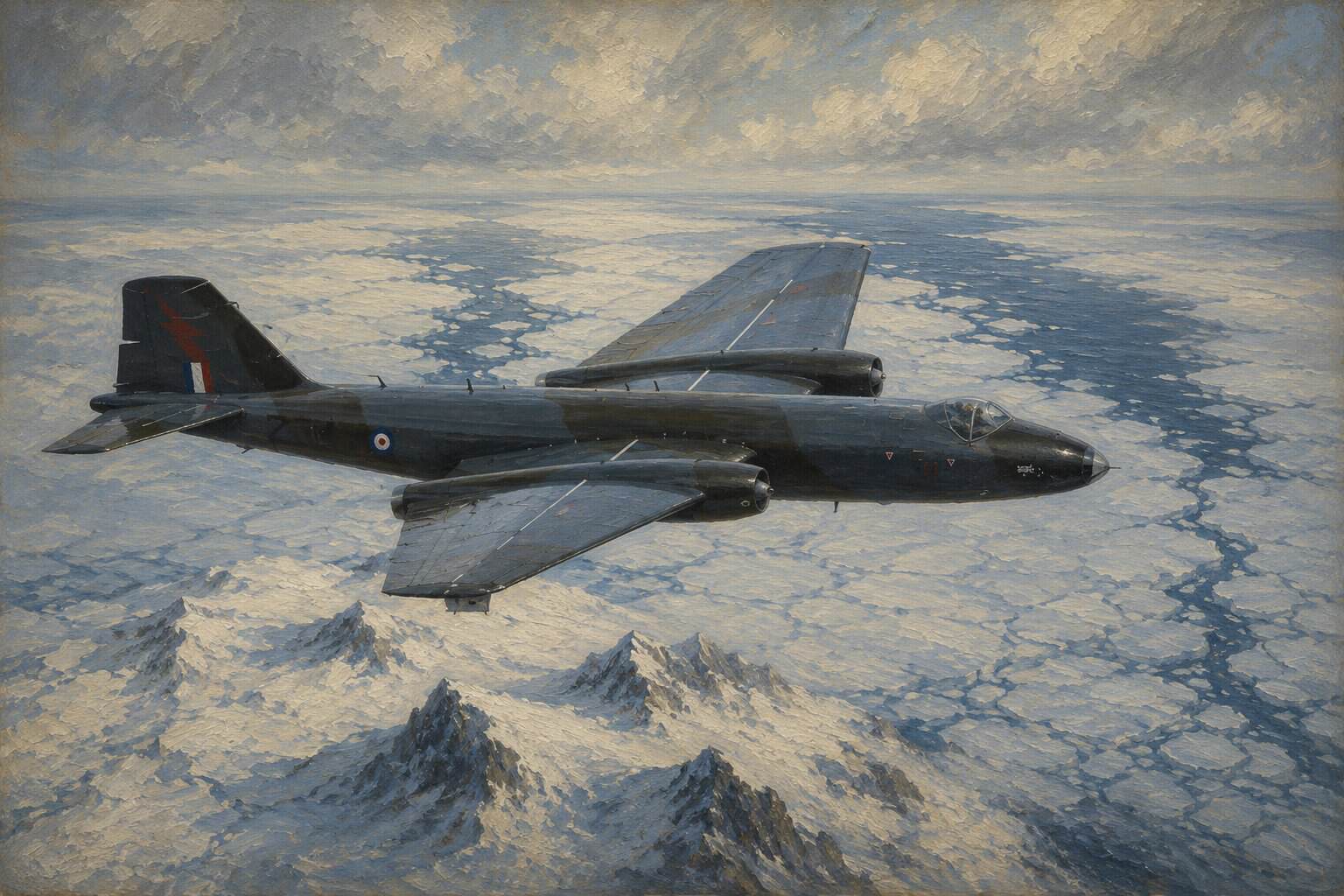
On 14 October 1954, the RAF Flying College’s English Electric Canberra B2 WH699, named Aries IV, set out from Bardufoss in Norway on a flight over the North Pole. Captained by Wing Commander Andrew Humphrey, the aircraft completed its journey at Bodø during an operation spanning 14–15 October. The flight lasted six hours and 43 minutes and achieved the first passage over the Pole by a jet aircraft.
For the RAF, the journey brought together the Canberra’s long-range capabilities and the specialised demands of polar navigation. A jet aircraft had to reach a remote geographical objective and then recover safely to a Norwegian airfield. The achievement depended on the crew’s ability to manage the whole route, from departure through the polar sector to the return south.
The Flying College’s Canberra
Aries IV belonged to the RAF Flying College, giving the flight a particular connection with advanced flying and navigation. The College’s work placed operational knowledge and airmanship alongside aircraft performance. A journey into the high Arctic provided a demanding setting in which those disciplines could be exercised together.
The Canberra supplied the platform for that work. Designed as a jet bomber, it also offered scope for flights concerned with range, endurance and navigation. WH699’s polar journey demonstrated the Canberra’s ability to undertake demanding long-distance flying and navigation at high latitudes. Its significance lay in the successful combination of aircraft, crew and route planning.
Humphrey’s role placed an experienced RAF officer at the centre of the undertaking. He would later become Marshal of the Royal Air Force Sir Andrew Humphrey. In October 1954, his responsibility was the practical business of taking Aries IV north from Norway and bringing it back safely after crossing the Pole.
Navigation at high latitudes
A polar flight presented distinctive geographical problems. Lines of longitude converge towards the Pole, changing the relationship between a plotted track and conventional directions. Magnetic navigation also becomes more difficult at high latitudes, increasing the importance of suitable procedures and careful position keeping.
The environment added another layer of difficulty. Over the Arctic Ocean, the ice and sea offered limited visual references compared with a route across well-mapped, populated terrain. Long distances between usable airfields made fuel planning and the choice of recovery airfield central considerations. For a jet crew, maintaining an accurate picture of progress was essential throughout the journey.
Bardufoss provided the departure point in northern Norway. From there, Aries IV flew to the North Pole before turning south towards Bodø. The two Norwegian airfields formed the endpoints of a journey whose central achievement took place far beyond the familiar landmarks of a normal overland flight.
A polar milestone for RAF jet aviation
The completed flight established a specific aviation first: a jet aircraft had flown over the North Pole. Its six-hour, 43-minute duration encompassed the journey from Bardufoss, the polar crossing and recovery at Bodø. The 14–15 October span remains important to the chronology of the achievement.
For the RAF Flying College, Aries IV’s journey connected advanced airmanship with the expanding reach of jet aviation. It demonstrated the Canberra’s usefulness on a demanding long-distance route and gave a concrete expression to the navigational challenges accompanying faster aircraft. The return to Norway completed an undertaking in which reaching the Pole and managing the flight home were inseparable parts of the same operational task.