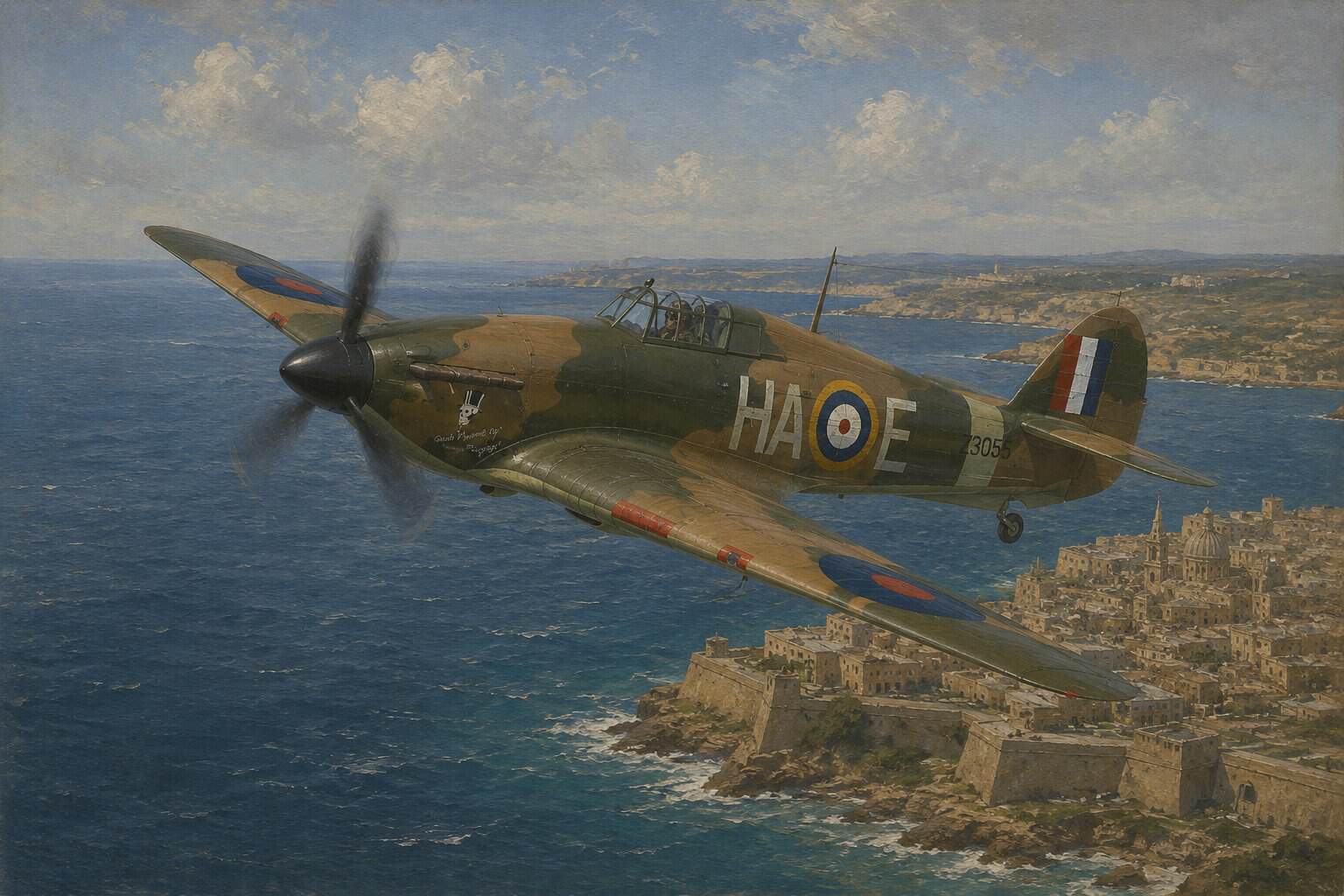
During the Second World War, the Mediterranean was never a self-contained theatre. It sat between Britain’s imperial routes, the Suez Canal, the oil resources of the Middle East, the sea lanes that sustained Malta, and the Axis effort to hold North Africa and southern Europe together. For the Royal Air Force, that meant a campaign spread across vast distances and sharply different operational problems. Airmen faced desert war in Egypt and Libya, siege conditions over Malta, maritime strike work in the central Mediterranean, difficult withdrawals in Greece and Crete, and later the sustained offensive that carried Allied power into Sicily and Italy.
What gives the Mediterranean air war its importance in RAF history is not simply its geographical scale, but the way the Service changed within it. In 1940 and 1941, the RAF in the theatre was often short of aircraft and modern equipment, and pulled in too many directions at once. By 1942 and 1943, it had become far better at linking air superiority, interdiction, reconnaissance, convoy protection, tactical support and strategic pressure into a more coherent whole. The Mediterranean did not produce a tidy or unbroken story of success, but it did show how the RAF moved from scattered survival towards offensive power in one of the war’s most demanding theatres.
A Theatre That Could Not Be Ignored
The Mediterranean mattered because it connected several wars at once. It was a naval theatre in which convoys, island bases and shipping losses could decide whether armies were sustained or isolated. It was an imperial theatre, because British power in Egypt, Palestine and the wider Middle East depended upon secure communications. It was also a continental theatre, since operations in North Africa, the Aegean, Sicily and Italy shaped the wider struggle against Germany and Italy. No single air problem dominated for long. The RAF had to think about air defence, bomber attack, army cooperation, anti-shipping strikes and long-range supply in the same theatre, often at the same time.
This complexity prevented easy solutions. Conditions over the Western Desert had little in common with the air fighting over Malta. The requirements of convoy escort were different again, while operations in Greece and Crete exposed the danger of fighting without adequate local air strength. The Mediterranean was therefore a testing ground not because it offered a single decisive model of air warfare, but because it forced the RAF to operate across several forms of war without the luxury of concentrating on a single one.
The theatre also carried political weight beyond its immediate battlefield results. A weakened British position in the Mediterranean threatened both prestige and strategy. The loss of sea routes, the collapse of Egypt, or the neutralisation of Malta would have carried consequences far beyond local command boundaries. That is why the RAF’s effort in the region can never be reduced to a supporting role for land and sea operations alone. Air power helped determine whether British and Allied strategy in the Mediterranean remained viable at all.
Early Weakness And Dispersed Commitments
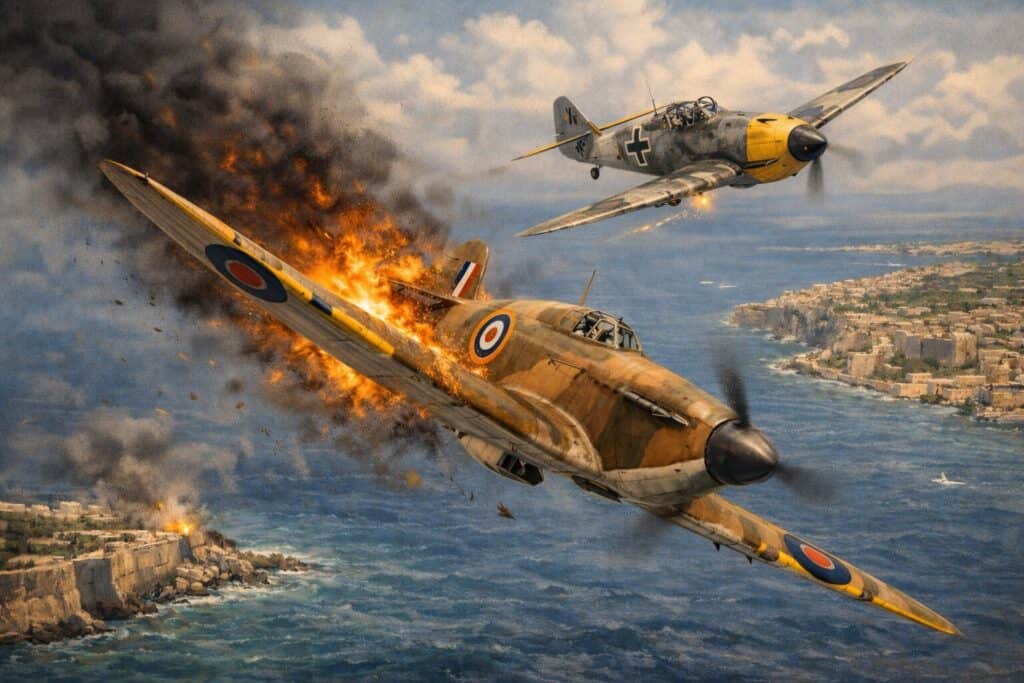
The opening period of the Mediterranean air war exposed serious RAF difficulties. Aircraft were often obsolescent or unsuited to the task; maintenance was hampered by climate and distance; and reinforcement competed with other urgent claims, especially after the fall of France and during the air defence of Britain itself. The RAF in the Middle East had to cover too much territory with too little strength. It could not rely on dense infrastructure or short lines of communication. Desert airfields were primitive, spare parts were slow to arrive, and units were frequently expected to improvise.
Even when the RAF achieved local successes, the wider position remained fragile. Italian weaknesses in the air could be exploited, but the arrival of German forces sharply altered the balance. The Luftwaffe brought greater striking power and experience, and it arrived at a moment when British commitments were already stretched. The campaigns in Greece and Crete underlined the danger of operating without sufficient air cover against a concentrated enemy air effort. These operations were not merely setbacks on the edge of the main desert war; they demonstrated how rapidly a weak air posture could make a wider strategic position untenable.
In North Africa itself, the RAF had to learn how to fight a mobile campaign over immense distances. Airfields shifted, fronts moved quickly, and the service relationship between air and ground commanders was not always settled. The temptation in such conditions was to scatter squadrons in penny packets, tying them too closely to local army demands and reducing their broader effect. The Mediterranean forced the RAF to confront a problem that would recur throughout the war: whether air power was to be used as a thin shield everywhere, or concentrated where it could shape the campaign.
This first phase was therefore defined by survival, but not by passivity. Experience accumulated in reconnaissance, communications, desert maintenance and the practical handling of a dispersed theatre. Losses and reverses were real, yet they also exposed which habits were wasteful and which methods had to change. The RAF that later dominated much of the Mediterranean was not built in comfort. It was built in a theatre that quickly punished weak organisation.
Greece, Crete And The Price Of Lost Air Superiority
The Greek campaign and the battle for Crete deserve special attention because they revealed, in unusually stark form, what happened when the RAF could not secure the air. In Greece, British and Commonwealth forces operated under acute pressure, with limited resources and an enemy able to concentrate forces more effectively. Air units were asked to support a deteriorating military situation while coping with shortages, relocation, and enemy attacks on the ground and in the air. The result was not simply defeat in one theatre, but a demonstration of how little room for manoeuvre remained once air inferiority became entrenched.
Crete made the lesson harsher still. The island held strategic value in the eastern Mediterranean. Yet its defence was compromised by weak local air power and the damage already suffered during the retreat from the mainland. German airborne and air assault forces were able to operate in conditions shaped above all by their control of the air. British bravery on the ground could not compensate for that absence. For the RAF, Crete was a reminder that air superiority was not a decorative advantage to be sought when convenient. In theatres dependent on reinforcement by sea and vulnerable to movement by daylight, it was the condition on which survival itself could depend.
These reverses did not define the rest of the Mediterranean war, but they sharpened RAF thinking. They reinforced the need to preserve air strength for decisive purposes, to protect bases and lines of communication, and to recognise that a campaign could collapse quickly when aircraft were too few, too exposed or too widely dispersed. Later success in the desert and over Sicily looks more impressive when set against Greece and Crete, because those campaigns had already shown the cost of failing to command the air.
Malta And The Fight For The Central Mediterranean
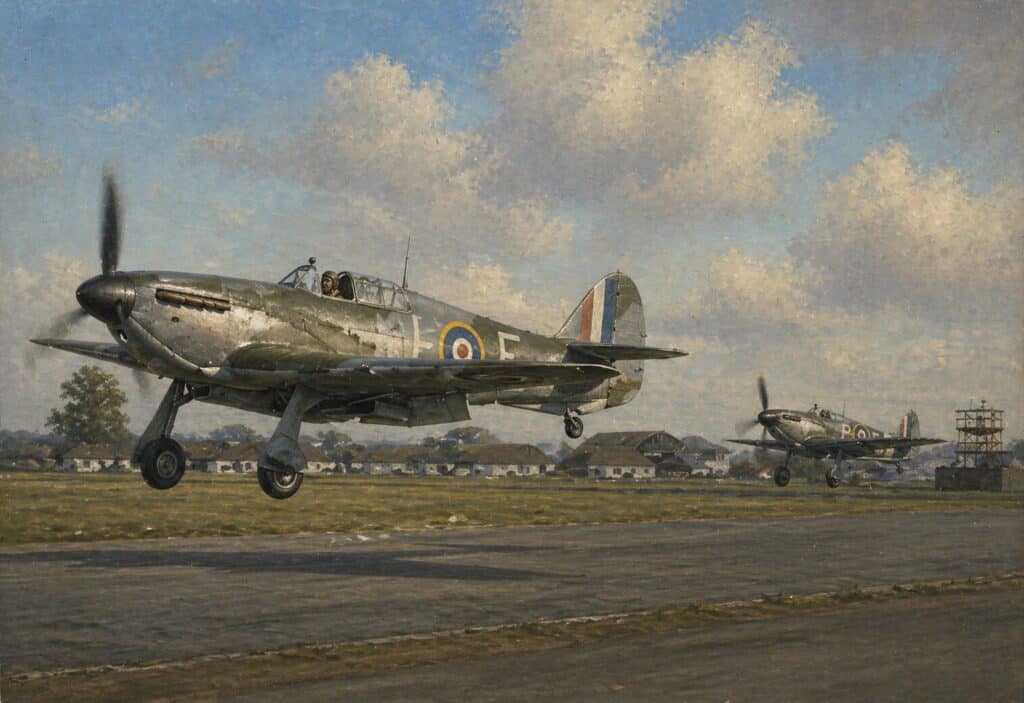
No part of the Mediterranean air war showed the connection between air power and strategy more clearly than Malta. The island was small, exposed and heavily attacked, yet its importance was out of all proportion to its size. From Malta, British forces could observe, harass and strike at the sea communications on which Axis armies in North Africa depended. If Malta survived and remained active, the central Mediterranean became dangerous for enemy shipping. If it was suppressed, Axis reinforcement and supply grew easier.
The struggle for the island was therefore about far more than local defence. The RAF on Malta had to endure prolonged air attack, shortages of fuel and aircraft, damage to airfields, and the constant strain of living under siege. For periods, the island’s fighter defence was perilously thin. Reinforcement efforts, including the delivery of new fighters by carrier, became matters of strategic urgency rather than administrative routine. The battle was fought in the air, on the ground and at sea, with every convoy and every serviceable aircraft carrying greater weight than its numbers alone would suggest.
Malta also demonstrated how an island air base could influence a wider land campaign. As British and Allied striking power from the island recovered, Axis convoys faced heavier pressure. Reconnaissance, torpedo attack, bombing and the coordination of different arms steadily increased the burden on the enemy supply. Rommel’s forces in North Africa depended on a long and vulnerable chain stretching back across the Mediterranean. Air attack could not win the desert campaign by itself, but it could reduce the flow of fuel, ammunition and vehicles on which offensive operations depended.
The island’s story also revealed a harder truth about RAF operations in the theatre. Air power in the Mediterranean often depended on endurance before it could become decisive. Malta had to survive first. Only then could it exert sustained pressure. In that sense, the island represented the wider campaign in miniature. The RAF could not leap directly from weakness to mastery. It had to hold key positions long enough for reinforcement, organisation and offensive capacity to catch up with strategic necessity.
The Desert Air War And The Rise Of Tactical Integration
The North African campaign was the largest and most sustained test of RAF air power in the Mediterranean. There, the Service learned, sometimes painfully, how mobile desert war changed the use of aircraft. Battles were not fought in the static pattern of the Western Front. Supply lines, concentrations, transport columns and forward landing grounds all became legitimate and important targets. The side that could see farther, strike more quickly and interfere more effectively with movement possessed an advantage that simple counts of aircraft did not always capture.
What emerged gradually was a more mature relationship between air operations and the land battle. Air power worked best when it was not broken into fragments for purely local protection, but used to secure broader effects: air superiority over the battlefield, pressure on enemy communications, attacks on armour and transport at critical moments, and support shaped by the commander’s operational intent rather than by panic demands from the front line. In the desert, the RAF moved towards a stronger understanding that control of the air and control of movement were closely linked.
This change is closely associated with leadership and doctrine, especially the work of senior commanders such as Arthur Tedder and Arthur Coningham. Their importance lay not in inventing an entirely new form of war from nothing, but in helping to impose clearer principles on a confused campaign. Aircraft had to be centrally directed enough to remain effective, yet responsive enough to support fast-moving operations. Tactical cooperation required better communications, more realistic planning and a refusal to waste air power on static habits carried over from earlier assumptions.
By the time of the decisive campaigns of 1942 and 1943, this stronger system was yielding results. Air superiority over the battlefield became more attainable, and the RAF was increasingly able to disrupt enemy movement by day, hit landing grounds, and support the tempo of Allied offensive action. El Alamein was not won by aircraft alone, but the desert air forces helped turn British numerical and logistical advantages into sustained operational pressure. In Tunisia, the effect grew stronger still. Air and land power were not identical, yet they were now working in a way that made each more effective than before.

Sicily, Italy And The Shift To Sustained Offensive Power
The invasion of Sicily marked an important transition in the Mediterranean air war. By 1943, the RAF and its Allied partners were no longer fighting merely to prevent collapse or protect a few isolated positions. They were shaping the conditions for amphibious assault, suppressing enemy air power, interdicting movement and preparing the way for operations that would carry the war onto European soil. Sicily showed what the Mediterranean theatre had become: not a distant defensive obligation, but a springboard for offensive action.
In the air campaign before the landings, Allied pressure on enemy airfields, transport networks, and shipping reflected lessons learned in previous years. Air superiority was treated as a prerequisite for major operations rather than an optional benefit. The RAF’s role extended across fighter cover, bombing, reconnaissance and maritime effort. The theatre’s diversity remained, but it was now being directed with far greater confidence. Where 1940 and 1941 had shown dispersion and uncertainty, 1943 showed concentration and purpose.
The campaign in Italy then extended that offensive posture into a more complex setting. Italy was not an open desert. Terrain, weather and the nature of the ground fighting imposed different limits. Yet air power remained central. The RAF operated in support of Allied armies, struck communications, defended sea routes, and used Italian bases to widen the reach of bombing and reconnaissance. Southern Europe now became accessible in ways that had been impossible when the Axis still dominated the central Mediterranean. The theatre’s geography had not changed, but the RAF’s command of it had.
At the same time, the Italian campaign reminded commanders that offensive air power did not remove friction. Mountainous terrain, difficult weather and stubborn ground fighting constrained what aircraft could achieve. The Mediterranean air war never became a story in which air superiority solved every problem below. What it did provide was freedom of movement, weight of attack and the ability to impose continual strain on enemy communications. That was enough to matter enormously, even if it was never enough to make the campaign easy.
Command, Coalition And The Remaking Of Allied Air Power
One reason the Mediterranean became so important in RAF history is that it was a theatre of command evolution. The RAF had to work not only with the Army and the Royal Navy, but increasingly with Allied air forces, especially the Americans, on a scale and intensity that demanded more than goodwill alone. Structures had to be built that could assign roles, reduce duplication, and prevent tactical, coastal, and strategic priorities from colliding. The Mediterranean was too broad and too active for ad hoc cooperation to suffice.
The command arrangements developed in the theatre reflected this necessity. Ideas associated with Tedder and Coningham gained weight because the theatre proved how destructive divided control could be and how valuable coordinated air policy could become. Strategic bombing, maritime operations, and tactical air support all had their place, but they had to be integrated into a single campaign design. This principle became clearer during the North African and Sicilian phases, and later under the broader Allied air command structures established for the Mediterranean.
That matters because the Mediterranean was not only a battlefield but also a workshop for coalition air warfare. British experience from the desert and Malta fed into later Allied practice, just as American strength and resources altered the scale on which operations could be mounted. The result was not a purely British system exported intact, but a combined method in which RAF experience carried genuine influence. The theatre helped show that effective air command required both concentration at the operational level and flexibility at the tactical edge.
In institutional terms, this was one of the Mediterranean War’s lasting contributions. The RAF emerged from the theatre with stronger proof that air power worked best when treated as a theatre instrument rather than as a mere collection of detached squadron tasks. The Mediterranean did not end all debate over command, but it supplied hard evidence, drawn from victory and failure alike, that organisation and doctrine were inseparable from combat effectiveness.
Limits, Costs And What The Mediterranean Changed
The Mediterranean air war should not be romanticised. Shortages, hard climates, crude landing grounds, shipping losses, abrupt retreats and constant logistical strain shaped it. Aircraft serviceability could be undermined by dust, heat, distance or simple overuse. Reinforcements arrived late, priorities clashed, and commanders often had to work with forces that were numerically or technically inferior at critical moments. Even in the more successful phases, the theatre demanded relentless effort to maintain operational momentum.
Nor should the campaign be reduced to a smooth upward curve from weakness to mastery. Greece and Crete exposed painful failures. Malta’s survival was never guaranteed. In North Africa, gains could be lost as quickly as they were won. Italy consumed time and resources long after initial expectations had faded. The Mediterranean remained a theatre in which air power was essential but not omnipotent. The RAF’s later competence is most meaningful when set against those realities rather than against a simplified legend of inevitable progress.
Yet the campaign changed the RAF in lasting ways. It deepened the Service’s understanding of tactical air power, air-ground coordination, interdiction, maritime-air cooperation and the command of large mixed air forces across a broad theatre. It also reinforced a broader lesson: air superiority was not an abstract ideal but the condition that made everything else possible. Without it, land and sea operations became precarious. With it, the RAF could do much more than defend. It could isolate battlefields, constrain enemy choices and prepare the way for offensive movement.
The Mediterranean occupies a central place in the wartime RAF story. It was not as symbolically concentrated as the Battle of Britain, nor as industrially vast as the bomber offensive over Germany. Its significance lies elsewhere. It showed the RAF learning, under pressure, how to connect air power to strategy across sea, desert, island, and mountain. Few other theatres demanded such range. Fewer still revealed so clearly that effective air warfare depended on organisation, endurance and theatre-wide purpose as much as on bravery in the air.
Conclusion
The RAF’s Mediterranean war began in weakness, over-extension and strategic anxiety. It matured into a theatre in which Allied air power could protect Malta, shape the desert campaign, open the way to Sicily and Italy, and operate with a coherence that had been absent in the earliest fighting. That transformation was neither simple nor complete, but it was real.
What the Mediterranean finally demonstrated was that RAF air power became most effective when it was treated as a connected instrument across the whole theatre. Air defence, maritime strike, interdiction, reconnaissance and tactical support were not separate stories. In the Mediterranean, they formed one cumulative effort, built painfully over time, through which the RAF moved from holding on to imposing pressure. That is why the theatre matters. It was one of the places where the RAF learned how offensive air power could be organised, sustained and made strategically decisive without ever becoming strategically simple.