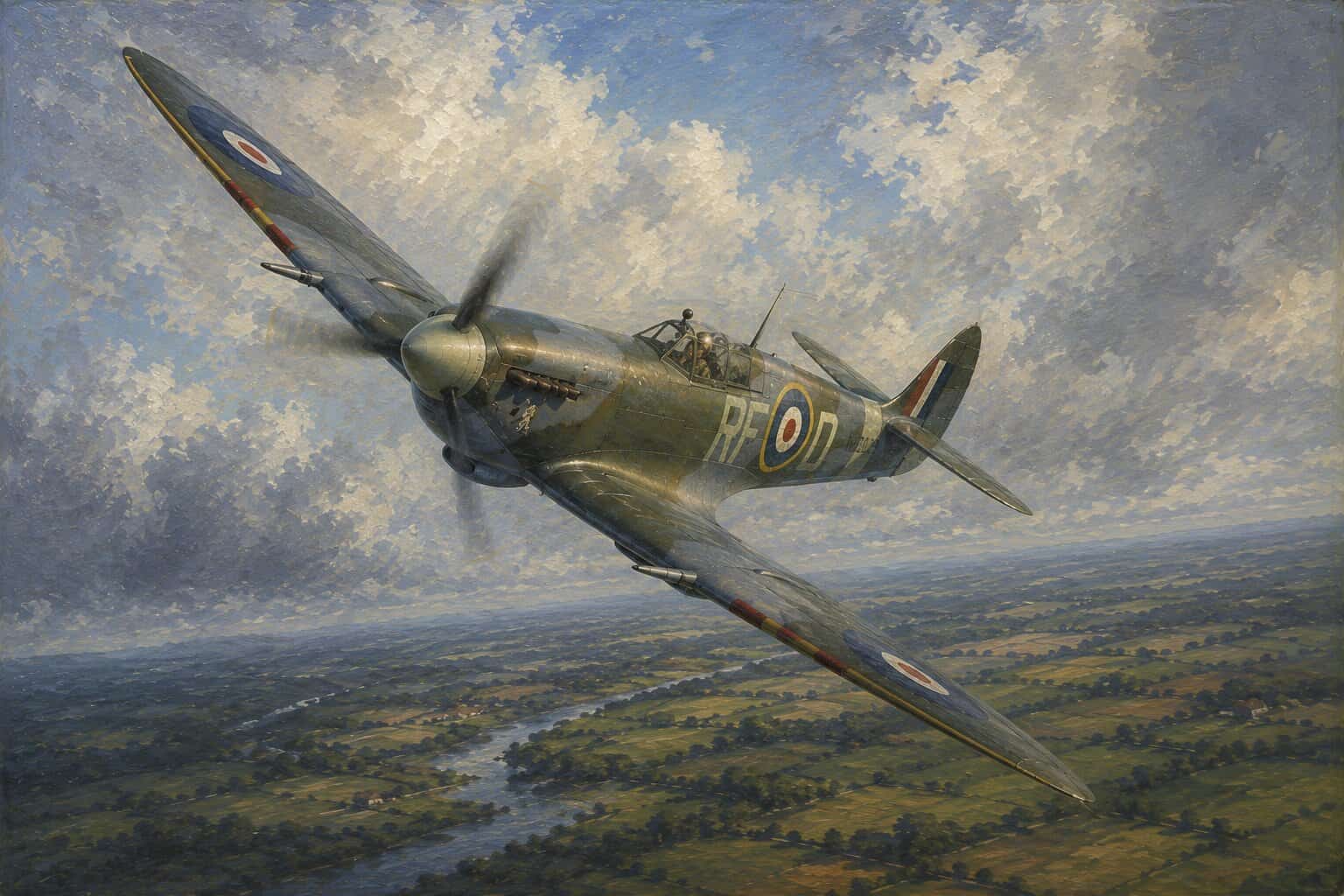
The Supermarine Spitfire is remembered for the Battle of Britain, but most of its wartime service came afterwards. It was developed through more than twenty marks, from the Merlin-engined Mk I of 1938 to the Griffon-engined Mk XIV, and fought over Europe, Malta, North Africa, Italy and Burma before flying its last RAF operational sortie in 1954.
What did the Spitfire do after the Battle of Britain?
After 1940 the Spitfire moved from defending Britain to taking the air war to the enemy: escorting bombers and flying fighter sweeps over France, defending Malta, fighting in North Africa, Italy and Burma, and flying unarmed photographic reconnaissance across Europe. New marks kept it competitive with the best German fighters until 1945.
The Hurricane carried more of the load in 1940, but it was the Spitfire’s capacity for development that kept it in front-line service through the whole war.
How was the Spitfire improved after 1940?
The Spitfire was improved mainly by fitting more powerful engines: the Mk V of 1941 added cannon and a stronger Merlin, the Mk IX of 1942 a two-stage supercharged Merlin, and later marks the bigger Rolls-Royce Griffon. Each new engine needed changes to the airframe, propeller and cooling, but the basic design took them all.
The Mk V was built in large numbers and became the main RAF fighter of 1941 and 1942, serving in Britain, Malta and North Africa.
Why was the Spitfire Mk IX built?
The Mk IX was rushed into service as an answer to the Focke-Wulf Fw 190, which outclassed the Spitfire V when it appeared over France in 1941. No. 64 Squadron at Hornchurch received the first Mk IXs in July 1942, and with 5,958 built, plus more than 1,000 of the similar Mk XVI, it was produced in greater numbers than any other mark (History of War).
In October 1944 a Spitfire IX of 401 Squadron RCAF was among the first Allied aircraft to shoot down a Messerschmitt Me 262 jet.
Where did the Spitfire serve outside Britain?
Spitfires reached Malta in March 1942 and, delivered in large numbers by aircraft carrier, helped win back control of the air over the island. They then fought in North Africa, Sicily and Italy, and from 1943 over Burma, where they gave the RAF the upper hand over Japanese fighters.
The Malta campaign is covered in the Chronicle’s article on RAF operations from Malta.
Did the Spitfire fly reconnaissance missions?
Yes. Unarmed photographic reconnaissance Spitfires, stripped of guns and fitted with extra fuel and cameras, photographed targets across occupied Europe, relying on speed and height to avoid interception. Their photographs supported Bomber Command’s raid planning and damage assessment throughout the war.
When did the Spitfire leave RAF service?
The RAF flew its last operational Spitfire sortie on 1 April 1954, when a PR.Mk XIX reconnoitred insurgent positions in Malaya (Royal Air Force). Griffon-engined Spitfires had served in Germany, Hong Kong and Malaya after 1945 before jets replaced them.
Why did the Spitfire last so long?
The Spitfire lasted because R. J. Mitchell’s design could take ever more powerful engines and new roles without being replaced, so the RAF kept a competitive fighter in production while its crews and ground crews stayed on a familiar type. Its fame was won in 1940, but its importance rests on the five years of service that followed.
The aircraft’s development is also told in the Chronicle’s podcast on how the Spitfire evolved, and its partner in 1940 on the Hawker Hurricane page.