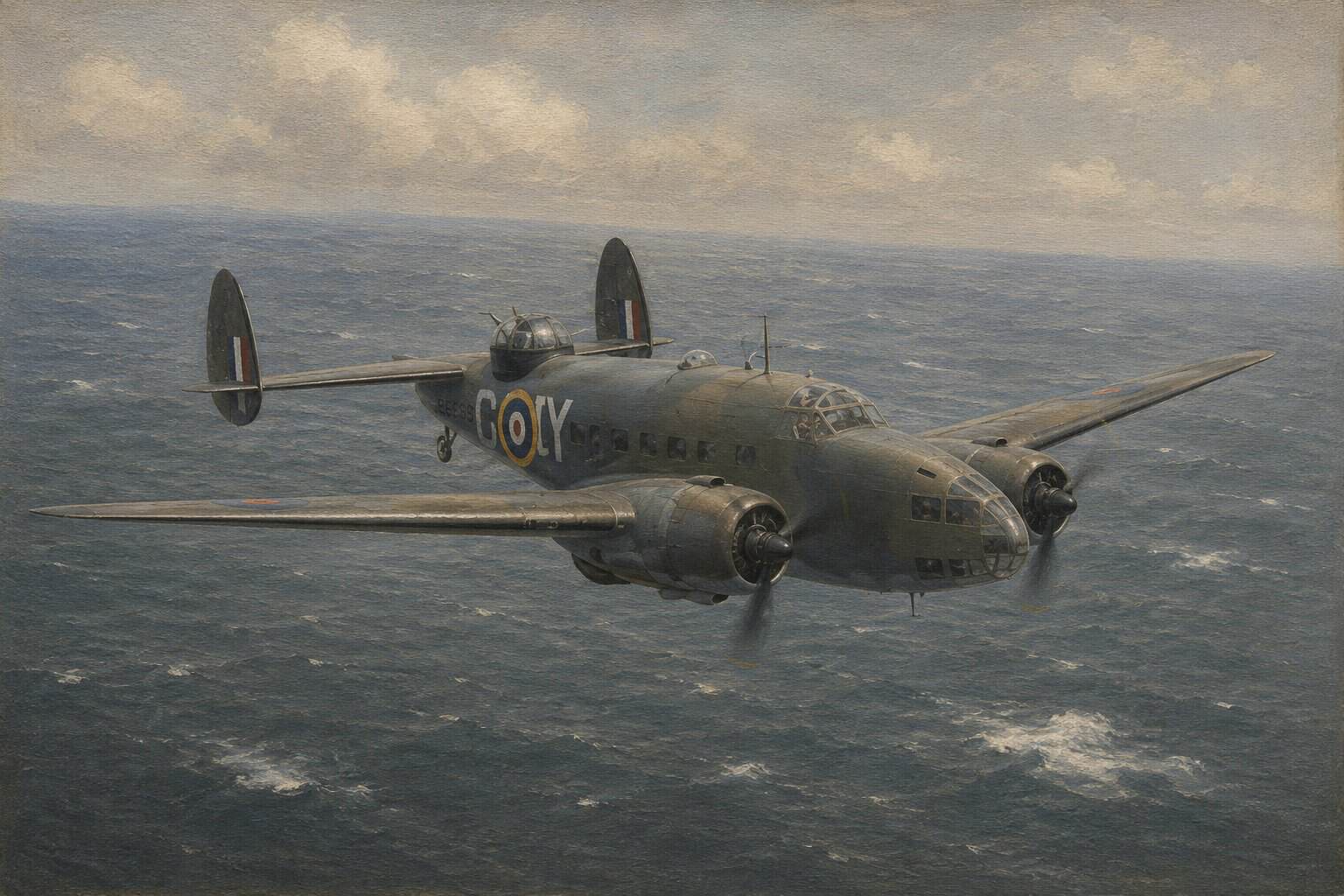
On 27 August 1941, RAF Coastal Command achieved one of the most unusual successes of the Battle of the Atlantic when Lockheed Hudson aircraft of No. 269 Squadron forced the German submarine U-570 to surrender south of Iceland. U-boats were expected to be sunk, damaged or driven off; they were not expected to haul down resistance in response to an air attack. Yet that is what happened, and the episode quickly became one of the most remarkable encounters in the air war over the Atlantic.
U-570 was on her first patrol when the incident occurred. Earlier in the day, one Hudson had already found the submarine, though that initial attack failed when the aircraft’s depth charges did not release. The contact was passed on, and a second Hudson of 269 Squadron, flown by Squadron Leader James Thompson, arrived as the U-boat surfaced. Thompson attacked at once, dropping four depth charges before the submarine could dive clear. At least one detonated extremely close to the boat, causing severe shock and disorder inside.
The Attack and the White Flag
The damage done by the near miss was enough to change the character of the action. U-570 resurfaced, and men began appearing on deck. Thompson’s Hudson fired on them, but the firing stopped when the German crew signalled surrender with a white sheet or board. For an RAF patrol aircraft to force such a result was almost unprecedented. The Hudson, operating far from shore in difficult North Atlantic conditions, had not simply struck a target but compelled it to submit. British accounts later indicated that the explosion had disabled systems, caused leaks and contaminated the atmosphere inside the submarine. U-570’s crew, inexperienced and on their first patrol, believed the boat could no longer continue the fight or dive safely. Whatever the exact balance between physical damage and human shock, the outcome was clear: the U-boat was left helpless on the surface under RAF observation.
Holding the Prize
Securing a surrender at sea was only the beginning. Aircraft could force the boat up, but they could not board and take possession of it themselves. Hudsons remained overhead while help was summoned. A Consolidated Catalina of No. 209 Squadron later relieved the patrol, shadowing the submarine for hours until surface vessels arrived. Eventually, trawlers and Royal Navy units took the surrendered boat in hand and brought her to Iceland, where she was beached and salvaged.
That sequence is central to the story. The success belonged not only to the attacking Hudson crew but also to the wider Coastal Command and naval system that could maintain contact, prevent escape or scuttling, and turn a fleeting tactical opportunity into a material capture. In anti-submarine warfare, where so many contacts ended in uncertainty, this was a rare case in which detection, attack, shadowing and recovery all worked together.
From U-570 to HMS Graph
The surrender had consequences beyond the day itself. U-570 was later commissioned into British service as HMS Graph, giving the event a second life in Allied hands. Captured enemy equipment was always valuable, and an intact Type VIIC submarine offered intelligence, technical and training benefits that no mere sinking could provide. The incident also carried a broader symbolic value. Coastal Command spent much of the war in a hard, attritional struggle that seldom produced dramatic set-piece moments. Here, however, was a result that could be clearly seen and easily understood: an enemy submarine compelled to submit under aerial pressure. It demonstrated the growing reach and persistence of RAF maritime patrols in the North Atlantic and showed how aircraft could dominate a U-boat once it had been fixed, attacked and kept under observation.
In the wider air-war story, the capture of U-570 remains memorable precisely because it was so unusual. It was not the typical outcome of anti-submarine patrol work. But its rarity is what makes it significant. It revealed both the vulnerability of a surfaced U-boat to well-handled air attack and the increasingly integrated Allied system that linked RAF patrol aircraft with naval recovery forces across the ocean battlefield.