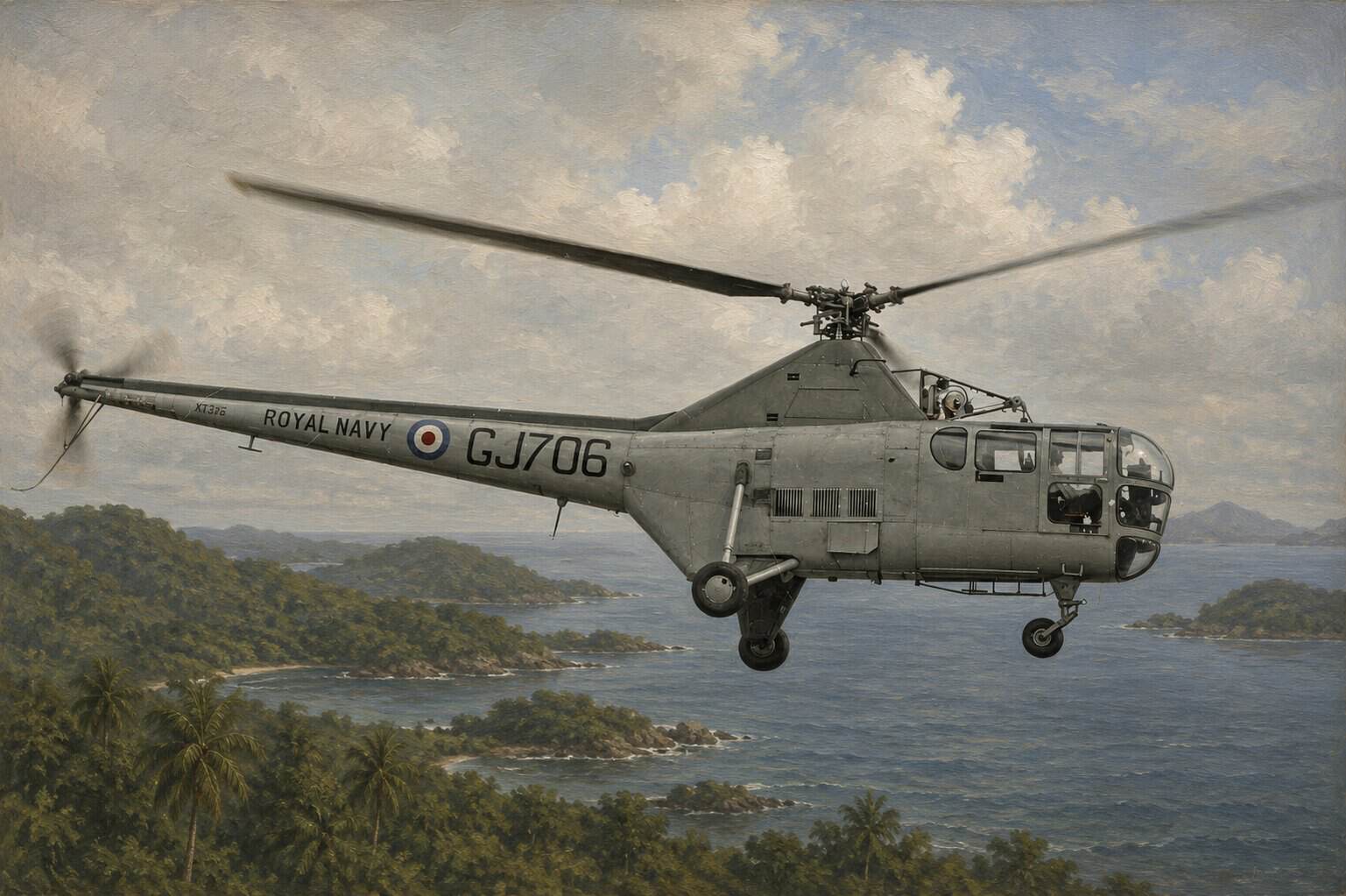
On 31 August 1953, Operation Cyclone began in Malaya with helicopters spraying herbicide on jungle crops used by insurgents. The operation was unusual, controversial and revealing. It showed the RAF participating in a form of warfare far removed from the set-piece air battles of the Second World War. In Malaya, air power was being adapted to counter-insurgency, where the objective was not the destruction of conventional armies but the gradual restriction of guerrilla survival, movement and support.
The Malayan Emergency and irregular war
The Malayan Emergency forced Britain to fight a campaign in which control depended on intelligence, movement, supply and persistence. Communist insurgents did not present the RAF with concentrated targets in the old sense. Instead, they operated through dispersed jungle networks, hidden camps and reliance on food cultivation in difficult terrain. That meant the campaign demanded methods intended to wear down irregular forces over time rather than defeat them in a single decisive blow.
Air power played an important role in this environment, though not always in familiar forms. Aircraft still carried troops and supplies, performed reconnaissance, and struck targets when required. Yet the Emergency also encouraged more experimental uses of aviation. Helicopters, in particular, expanded the possibilities of counter-insurgency by making difficult terrain more accessible and by allowing pressure to be exerted in places that road-bound forces struggled to reach.
Why Cyclone mattered
Operation Cyclone reflected that wider shift. By targeting jungle crops associated with insurgent support, the operation aimed to make guerrilla survival harder and to interfere with the local systems on which resistance depended. The use of helicopters for herbicide spraying was therefore part of a broader effort to combine mobility, surveillance, and economic pressure into a single campaign method.
This did not make the policy simple or morally untroubled. Counter-insurgency operations often blurred the line between tactical military necessity and wider political consequence. The destruction of food sources had implications beyond immediate battlefield effect, and air control in jungle war raised questions quite different from those posed by conventional bombing or fighter combat. Cyclone is significant partly because it exposes that change in RAF activity. The Service was not merely supporting a colonial emergency from a distance. It was becoming directly involved in the tools of population control, movement denial and environmental intervention.
Helicopters and a changing RAF role
The operation also points to the increasing importance of helicopters in post-war air warfare. Rotary-wing aircraft made possible tasks that older fixed-wing systems could not perform with the same precision or flexibility in close jungle conditions. In Malaya they became part of a wider redefinition of what air power could do in limited war.
For the RAF, this was institutionally important. The Service that had become famous through bomber offensives and fighter defence was now proving its usefulness in dispersed imperial conflict. Operation Cyclone belongs to that story of adaptation. It showed that aviation could be used not only for dramatic strike or transport work, but for incremental pressure in support of a campaign of attrition.
Significance
The beginning of Operation Cyclone on 31 August 1953 matters because it marks the RAF's adjustment to irregular warfare in the early Cold War world. It demonstrates the expanding use of helicopters, the practical experimentation of the Malayan campaign and the way air power was woven into counter-insurgency strategy. In RAF history, Cyclone stands as an example of how the Service adapted to a form of conflict in which success depended less on spectacular destruction than on sustained pressure, reach and control.