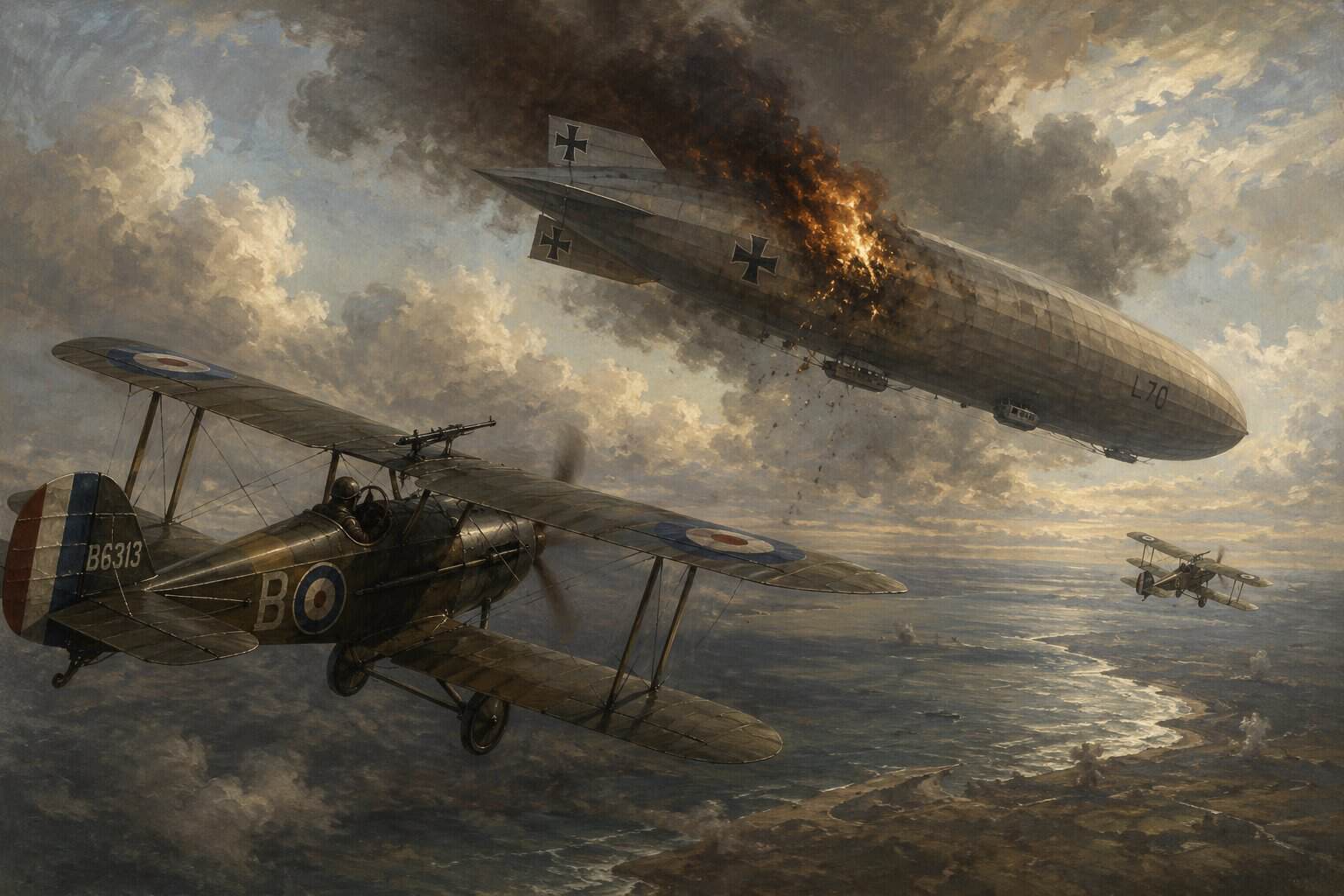
On 5 August 1918, a German naval airship raid against Britain miscarried, and the failure became even more striking when one of the attacking Zeppelins, L70, was brought down by RAF aircraft. The loss was especially important because L70 carried Peter Strasser, commander of Germany’s naval airship service and one of the principal advocates of Zeppelin attacks on Britain. In both military and symbolic terms, it was a severe blow to a campaign that had already lost much of its earlier menace.
The waning threat of the Zeppelin
In the first years of the war, the German airship raids had caused alarm out of proportion to their material effect. Zeppelins could reach Britain when air defence was still immature, and their appearance over towns and cities carried a heavy psychological charge. Over time, however, improvements in British warning, fighter tactics, anti-aircraft measures and incendiary ammunition steadily reduced their chances of success.
By 1918, the balance had changed decisively. Airships still possessed range and endurance, but they were increasingly vulnerable, especially when forced to operate in conditions that exposed them to interception. The raid of 5 August showed how far the situation had moved. Five naval Zeppelins were dispatched toward the Midlands, yet the attack failed to achieve its purpose and instead handed Britain an important defensive victory.
The destruction of L70
The most notable result came over the North Sea approaches, where RAF aircraft intercepted L70. The airship was attacked and destroyed, falling in flames with all aboard. The death of Strasser gave the episode significance far beyond the loss of a single craft. He had become identified with the strategy of using giant naval airships against Britain, and his presence in the destroyed Zeppelin turned an unsuccessful raid into a major symbolic defeat.
What mattered here was not merely that one interceptor succeeded, but that British air defence had become capable of defeating a weapon once considered difficult to stop. The Zeppelin’s great size, endurance and altitude had once seemed to give it a special freedom of action. By August 1918, that assumption no longer held. British aircraft could find, reach and kill even the most prestigious of these raiders.
A turning point in air defence
The failure of the raid reflected broader changes in the air war. Britain’s defensive system had become more coordinated, more confident and more technically effective. That evolution is easy to overlook because later bombing campaigns were fought on a vastly greater scale, but it mattered deeply at the time. Defeating the Zeppelin threat required adaptation in equipment, tactics and command.
There was also a wider historical lesson. Air power is rarely static. A weapon that appears revolutionary in one phase of war can become vulnerable in the next once opponents learn how to detect, intercept and counter it. The Zeppelin offensive followed exactly that pattern. Its terror value faded as British defences improved and as the attackers paid a steadily rising price for each effort.
In wider air-war terms, 5 August 1918 marked the near-end of an era. The destruction of L70 showed that the giant airship had ceased to be a decisive instrument against Britain. The raid failed, the leading apostle of the campaign was killed, and the RAF demonstrated that even the most formidable-looking aerial threat could be mastered. It was an important victory in the long development of British air defence.