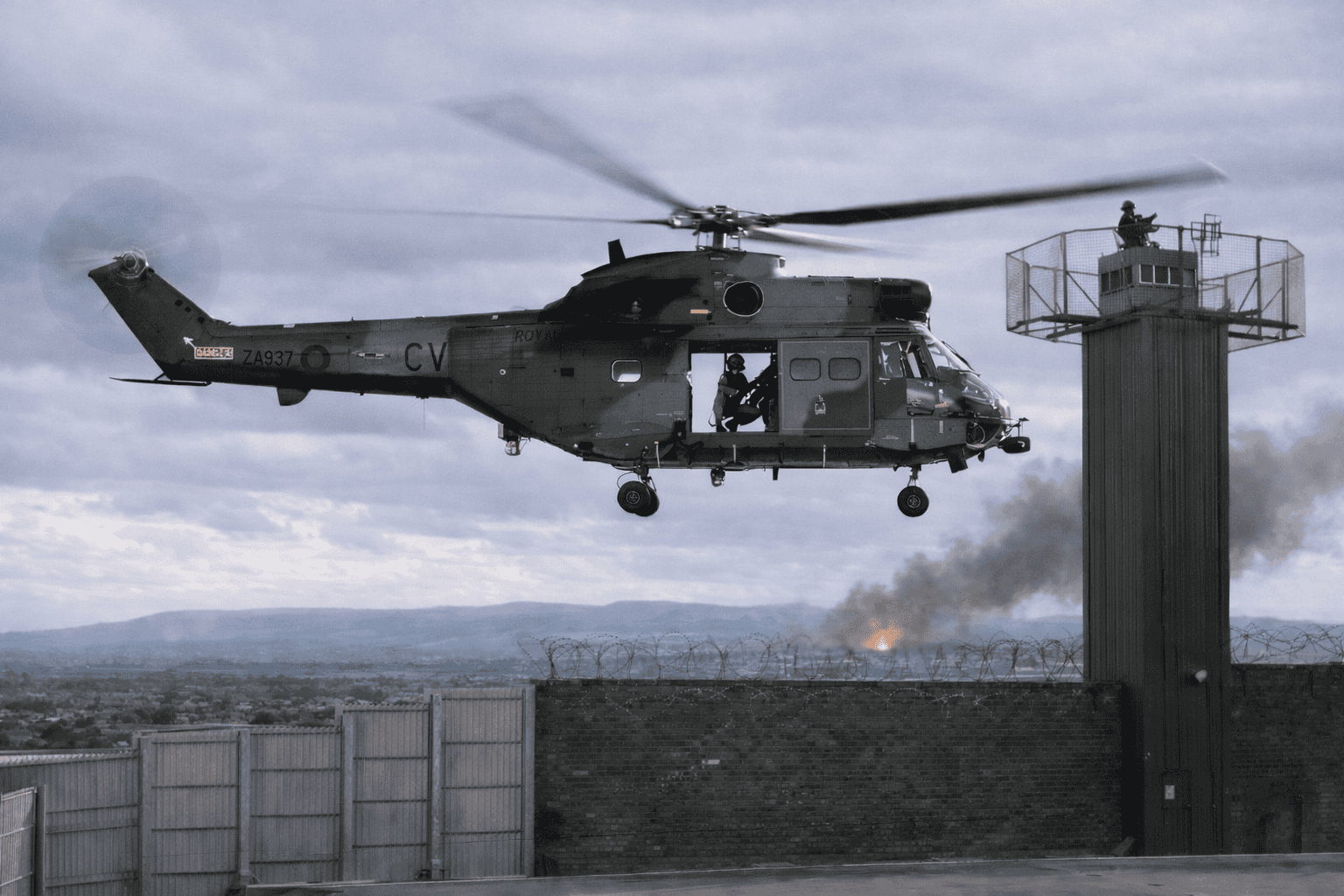
The RAF contribution to the Troubles in Northern Ireland was shaped less by offensive air action than by sustained support, mobility and surveillance across a long internal-security campaign. From the deployment of British troops in 1969 under Operation Banner, air power became an essential part of the military structure that supported movement, reinforcement, casualty evacuation and specialist tasks throughout the province.
Its role was often less visible than that of troops on the ground, but this should not obscure its importance. Northern Ireland imposed a difficult operational environment in which road movement could be vulnerable to ambush and explosive attack, distances were short but politically sensitive, and the need for constant logistic and operational flexibility was high. RAF flying therefore became central to the maintenance of British military presence.
Operation Banner and the Air Bridge
When British forces were first deployed in August 1969, the requirement for rapid reinforcement and sustained logistic support created an immediate need for reliable air movement between Great Britain and Northern Ireland. RAF Aldergrove became the principal military airhead for this activity, serving as the main arrival point for personnel, stores and later specialist air support.
The RAF’s early task was not combat in the conventional sense but the maintenance of a permanent air bridge. Fixed-wing aircraft moved troops, equipment and supplies into the theatre and helped sustain rotations over many years. This was a logistical rather than dramatic form of air power, but it underpinned the entire military commitment.
The existence of the air bridge also reduced dependence on slower or more vulnerable alternatives and gave the authorities greater flexibility in reinforcement and redeployment. In this respect, RAF activity in Northern Ireland belongs to the wider history of post-war British military mobility rather than to the history of conventional air campaigns.
Helicopter Operations and Tactical Mobility
The importance of rotary-wing support grew as the campaign developed, especially in areas where road movement exposed troops to high risk. Helicopters allowed forces to bypass vulnerable routes, reinforce isolated locations and sustain remote observation posts and bases.
Aircraft such as the Westland Wessex and later other helicopter types were used for troop movement, resupply and casualty evacuation. In places such as South Armagh, where the threat from ambush and explosive devices became especially acute, helicopter mobility reduced dependence on predictable ground routes and helped maintain a British security presence in difficult terrain.
This was a practical and continuous contribution rather than a series of isolated dramatic missions. The cumulative effect of such flying was to alter how forces could be moved and sustained inside the theatre. In that sense, RAF support aviation shaped the pattern of military operations in Northern Ireland in a direct though often understated way.
Surveillance, Intelligence and Specialist Tasks
As the Troubles continued, RAF activity also developed in the direction of surveillance and specialist support. Airborne observation, communications support and assistance to wider intelligence and counter-terrorist structures formed part of the RAF contribution, even where the most sensitive aspects of those tasks remained less visible in public record.
This reflected the changing character of the campaign. Northern Ireland did not present a conventional battlefield, so air power was valuable less for destructive force than for visibility, mobility, surveillance and rapid response. The RAF contribution therefore broadened from transport and helicopter lift towards a more complex support role in which aviation helped connect intelligence, movement and security operations.
Operational Strain and Risk
Although RAF flying in Northern Ireland was primarily supportive rather than offensive, it was not without risk. Airfields and aircraft associated with British military operations formed part of the wider security threat environment, while flying itself placed continuous demands on aircrew and support personnel over many years.
The long duration of Operation Banner meant that the RAF contribution should be understood as sustained operational strain rather than as a short exceptional deployment. Its importance lies partly in that persistence: Northern Ireland required a regular, disciplined and adaptable air effort over decades rather than in a single campaign season.
Historical Significance
The RAF role in the Troubles is historically significant because it shows air power applied to internal security and military support in a form very different from the RAF’s better-known wartime image. Northern Ireland demanded mobility, continuity and specialist support rather than conventional air battle. It therefore offers an important case study in the flexibility of post-war RAF operations.
It also helps explain how the RAF fitted into wider British security policy during the later Cold War period. The campaign belonged to a strategic world shaped by Cold War commitments elsewhere, yet it required a local and highly practical use of air power inside the United Kingdom itself.
Conclusion
RAF operations in Northern Ireland during the Troubles were built around transport, helicopter mobility, surveillance and wider support to Operation Banner. Their importance lay not in visible air combat, but in the maintenance of military movement, operational flexibility and sustained support across a prolonged internal-security campaign.
For RAF history, the Northern Ireland campaign remains significant as an example of air power used in support, mobility and surveillance roles under politically sensitive and long-duration conditions. It stands apart from the Service’s conventional warfighting image, but forms an important part of its post-war operational record.