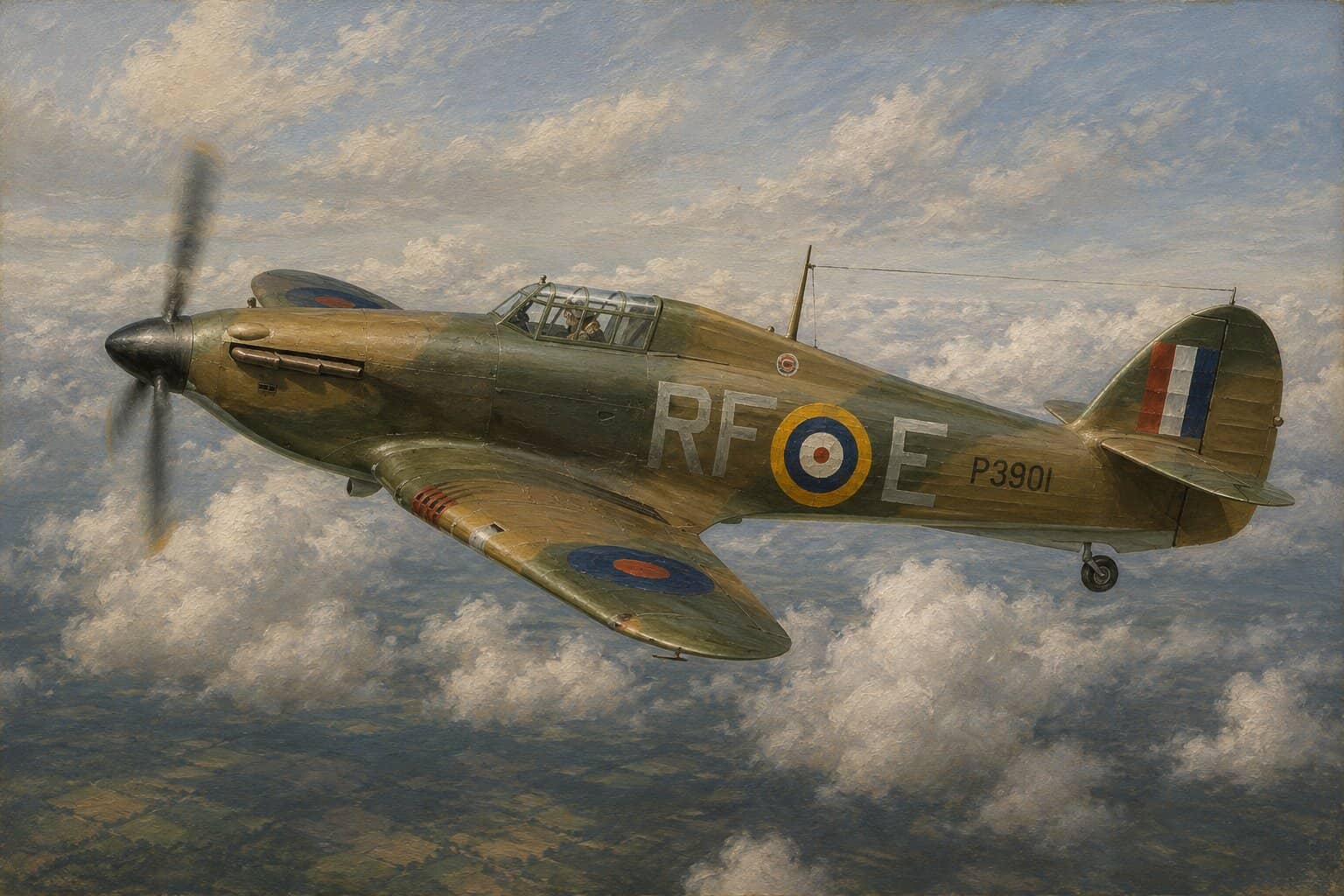
On 30 August 1940, No. 303 (Polish) Squadron stood on the verge of operational service as its Hurricane work-up neared completion. At that moment, the unit had not yet secured the reputation it would later hold as one of the most successful squadrons of the Battle of Britain. Yet the importance of the date lies precisely in that threshold. It marks the point at which an already desperate air campaign was about to be joined by a formation whose impact would quickly become exceptional.
A squadron formed in urgency
The summer of 1940 placed enormous pressure on Fighter Command. The Luftwaffe was attacking in strength, pilots were being lost and replaced, and every effective squadron mattered. In those circumstances, the arrival of trained Polish airmen was of real military value. Many had already fought in 1939 and 1940, carrying combat experience that Britain could ill afford to ignore. Their route into RAF service, however, was not immediate or simple. Language, procedure, and organisational adjustment all had to be addressed before they could enter battle.
No. 303 Squadron emerged from that process. Equipped with Hawker Hurricanes and built around Polish personnel serving within the RAF system, it represented both practical reinforcement and a wider political fact: Britain’s air defence in 1940 was already an Allied undertaking. The squadron’s preparation period was therefore more than routine training. It was the conversion of the experience of exile into front-line RAF strength.
Readiness at a critical moment
By the end of August, timing could hardly have been more important. The Battle of Britain had entered one of its decisive phases, and the demand for squadrons ready to fight remained intense. For 303 Squadron, nearing operational service meant joining the battle not as a symbolic addition but as a unit expected to contribute immediately under heavy pressure.
That expectation would soon be justified. Within days, the squadron began the sequence of operations that made it famous. Its subsequent score and aggressive effectiveness became central to its legend, but on 30 August, none of that was yet guaranteed. What existed instead was a unit trained in haste, committed at a moment of national danger, and tasked with proving itself within a new command system.
The wider meaning of 303 Squadron
The squadron’s later success tends to dominate remembrance, but its readiness stage deserves attention as well. It shows how Fighter Command was absorbing experienced Allied manpower at the very moment it most urgently needed reinforcement. It also demonstrates how quickly the RAF could integrate men from outside Britain into a functioning squadron under combat conditions.
For the Polish airmen themselves, nearing operational service had a significance beyond RAF procedure. It was the point at which defeat and exile were being turned into renewed combat. The Battle of Britain gave them another chance to fight Germany, and 303 Squadron became one of the clearest expressions of that continuing resistance.
Significance
30 August 1940 matters because it captures 303 Squadron immediately before achievement hardened into reputation. The date belongs to the preparation, expectation and imminent commitment that preceded its extraordinary Battle of Britain record. In RAF history, it reminds the reader that victory in 1940 depended not only on British endurance, but on the rapid integration of Allied airmen whose skill and determination would soon prove decisive in the air over southern England.