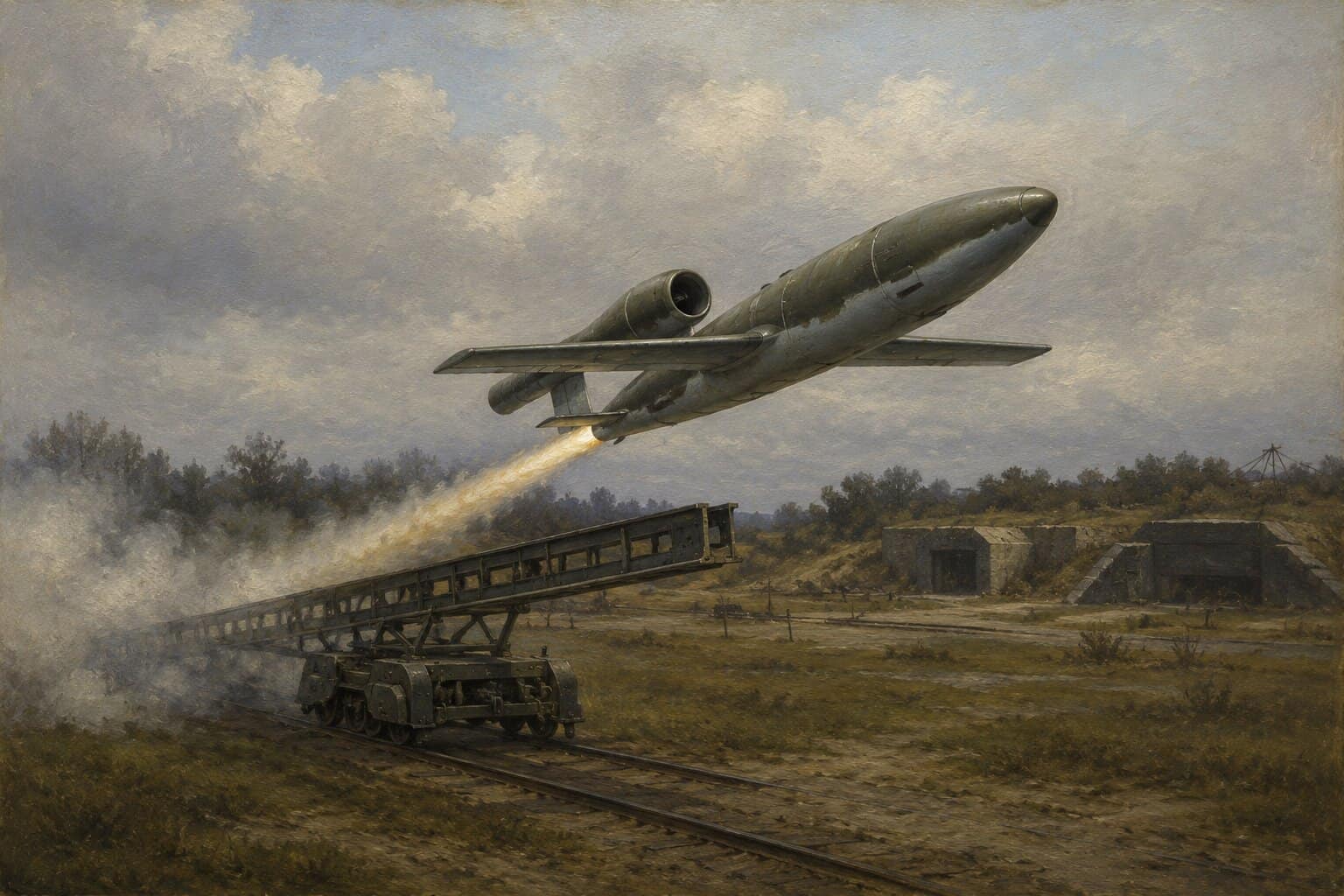
From 13 June 1944, a week after D-Day, Germany launched V-1 flying bombs at London from sites in northern France. The RAF answered with Operation Diver, a defence of fighters, anti-aircraft guns and barrage balloons that by the end of the summer was destroying most of the flying bombs before they reached the capital. By April 1945 the threat to Britain had shrunk to single aircraft, and the Luftwaffe’s last operation over Britain was a lone jet reconnaissance flight on 10 April.
How did the RAF defend against the V-1?
The RAF defended against the V-1 by flying standing patrols of its fastest fighters over the Channel and the Kent and Sussex countryside, guided by radar and ground control, while anti-aircraft guns and a balloon barrage formed further belts closer to London. Fighters shot down about 1,800 V-1s, roughly the same number as the guns, and balloons brought down about 200 (Imperial War Museums).
Almost 10,000 V-1s were launched at London, and thousands of people were killed and wounded by those that got through.
What was the V-1 flying bomb?
The V-1 was a pilotless flying bomb powered by a pulse-jet engine, carrying a warhead of nearly a ton and flying a fixed course until its engine cut out over the target. It flew at 350 to 400 mph at between 3,000 and 4,000 feet (HistoryNet), a height too low for heavy guns to track easily and a speed too high for most fighters to catch.
The first V-1 to hit London fell at Bow on 13 June 1944, killing six people.
Which RAF aircraft shot down V-1s?
The Hawker Tempest V was the most successful anti-V-1 fighter, alongside the Griffon-engined Spitfire XIV, the Mustang and, at night, the de Havilland Mosquito. These were among the few aircraft fast enough at low level to overtake a flying bomb.
The RAF’s first jet, the Gloster Meteor of 616 Squadron, joined the defence in July 1944.
How did pilots bring down V-1s?
Most V-1s were shot down with gunfire, which was dangerous because the warhead could explode in front of the attacking fighter. Some pilots instead flew alongside and used their wingtip, or the airflow over it, to tip the bomb over and topple its gyroscope.
On 4 August 1944 Flying Officer T. D. “Dixie” Dean of 616 Squadron did this in a Meteor after his guns jammed, bringing down the first V-1 destroyed by a jet; later that day a second Meteor pilot shot one down with cannon.
How was Operation Diver reorganised?
At first the guns and fighters got in each other’s way over the same area. In mid-July 1944 the anti-aircraft guns were moved to the coast, giving them a clear field of fire over the sea, while the fighters patrolled inland and over the Channel in separate zones.
The guns, now firing new proximity-fused shells and directed by American radar, became far more effective, and the share of V-1s brought down rose sharply over August.
When did the V-1 campaign end?
By late August 1944 Allied armies had overrun most of the launch sites in northern France, and the main assault on London ended. Germany then fired V-1s from aircraft over the North Sea and from sites in the Netherlands until March 1945, while turning its main V-1 effort against Antwerp.
The V-2 rocket, which could not be intercepted at all, followed from September 1944.
Why does the V-1 campaign matter?
The V-1 campaign was the first defence against cruise missiles, and it showed that the warning, control and coordination built for the Battle of Britain could be adapted to a wholly new kind of attack within weeks. It also diverted large numbers of fighters, guns and bombers from other tasks in the summer of 1944.
The earlier development of that defence system is told in the Chronicle’s article on RAF Fighter Command.