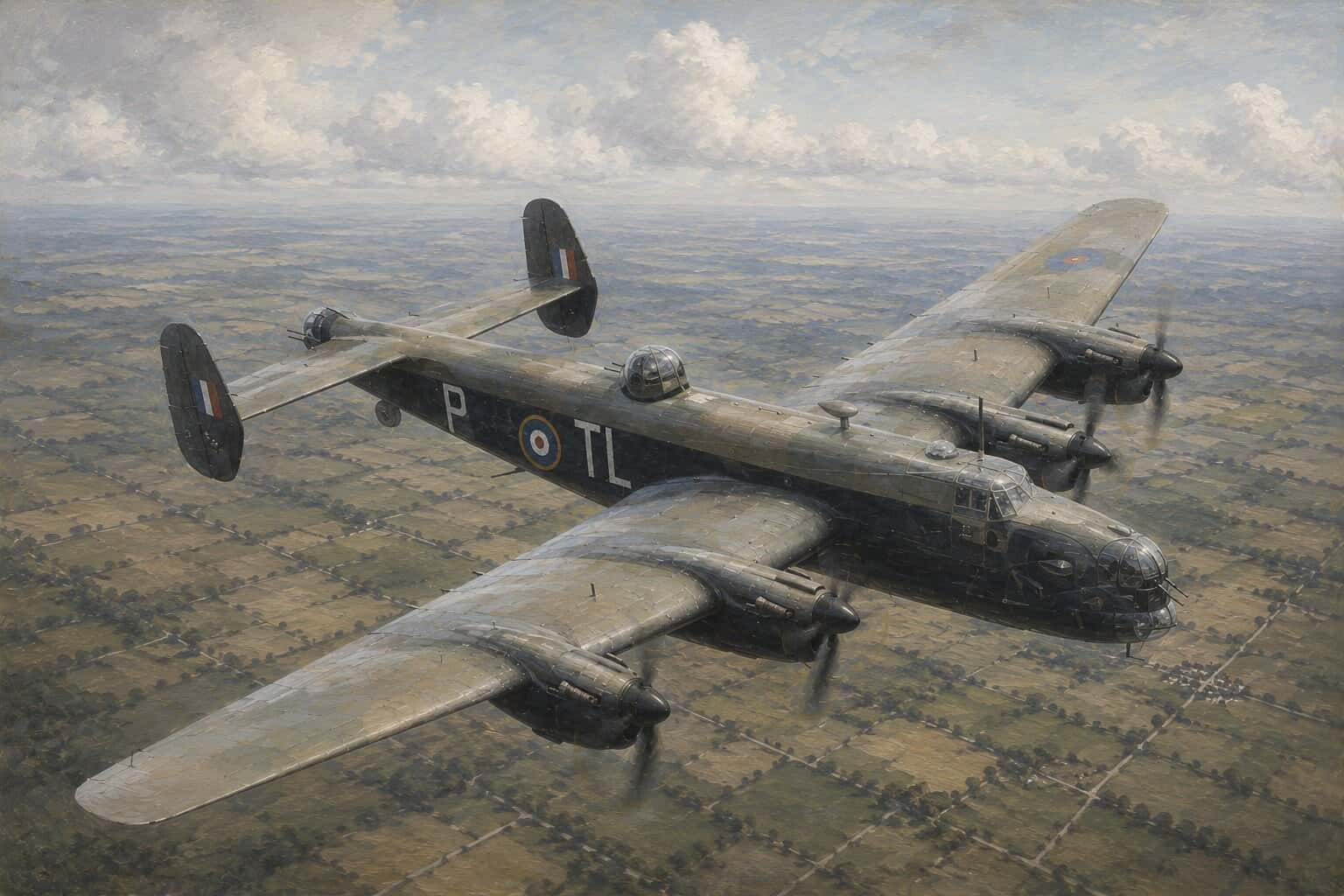
On the night of 28–29 June 1943, Handley Page Halifax HR837 of No. 158 Squadron joined the bomber stream bound for Cologne and returned with one of the most extraordinary survivals of the air war. Over the target, the aircraft was struck not by German fire alone but by a falling Allied bomb released from above. The blast and impact tore a great hole through the fuselage, yet Sergeant Douglas Cameron still flew the Halifax back to RAF Lissett and landed without injury to the crew.
Danger in the bomber stream
The raid on Cologne was part of Bomber Command’s continuing offensive against Germany’s industrial and urban centres. By mid-1943, these operations were being mounted on a large scale, with heavy bomber streams concentrated in time and space to saturate defences. That system offered real advantages against night fighters and flak, but it also created dangers of its own. Aircraft flew in darkness, often in cloud, under stress and amid intense manoeuvring. The risk of collision or accidental damage from friendly aircraft could never be entirely removed.
HR837 encountered exactly that sort of danger over the target area. While flying beneath other bombers at roughly 20,000 feet, it was hit by a 1,000-pound bomb falling from an aircraft above as the attack developed over Cologne. The bomb passed through the fuselage in front of the mid-upper turret, causing severe structural damage. Photographs taken afterwards showed a hole so large that the aircraft’s survival appeared almost improbable.
Cameron’s return to Lissett
To keep such a machine airborne required skill, composure and trust among the crew. Cameron had to judge whether the Halifax would remain controllable, handle any changes in handling, and bring the aircraft home across the North Sea rather than abandoning it. The crew, for their part, had to remain disciplined and ready for every possibility while nursing a badly damaged heavy bomber back to Yorkshire.
They succeeded. HR837 landed safely at Lissett in the early hours, and the entire crew escaped injury. That outcome matters because it reminds us that survival in Bomber Command was not only a matter of armour, engines or luck. It also depended on calm flying, internal teamwork and the ability to make sound decisions in conditions where failure could become final very quickly.
More than an isolated lucky escape
The incident has often been remembered because the damage was visually dramatic, but its significance runs deeper. Bomber Command losses are usually associated with enemy action, and rightly so, yet HR837’s ordeal shows the strain placed on crews by the sheer scale and density of the night offensive. The bomber stream was an operational innovation, but it also brought a hazardous environment in which airmen faced danger from every direction.
The fact that HR837 was repaired and returned to service adds another layer to the story. Wartime aircraft were not always disposable after major damage; ground crews and repair organisations could restore machines that seemed beyond saving. In that sense, the safe return of the Halifax also points to the wider system of effort behind every sortie.
A wider reflection on Bomber Command service
On 29 June 1943, the RAF did not gain a headline victory from HR837’s experience. What it gained was a striking example of professionalism under extreme circumstances. Sergeant Cameron and his crew demonstrated the steadiness that heavy bomber operations demanded night after night, whether the threat came from enemy guns, fighters or the dangerous realities of crowded operations over a defended target.
That is why this episode still deserves to be remembered. It captures both the vulnerability and resilience of Bomber Command: a heavy bomber torn open in the middle of a raid, and a crew who refused to let that be the end of their story.