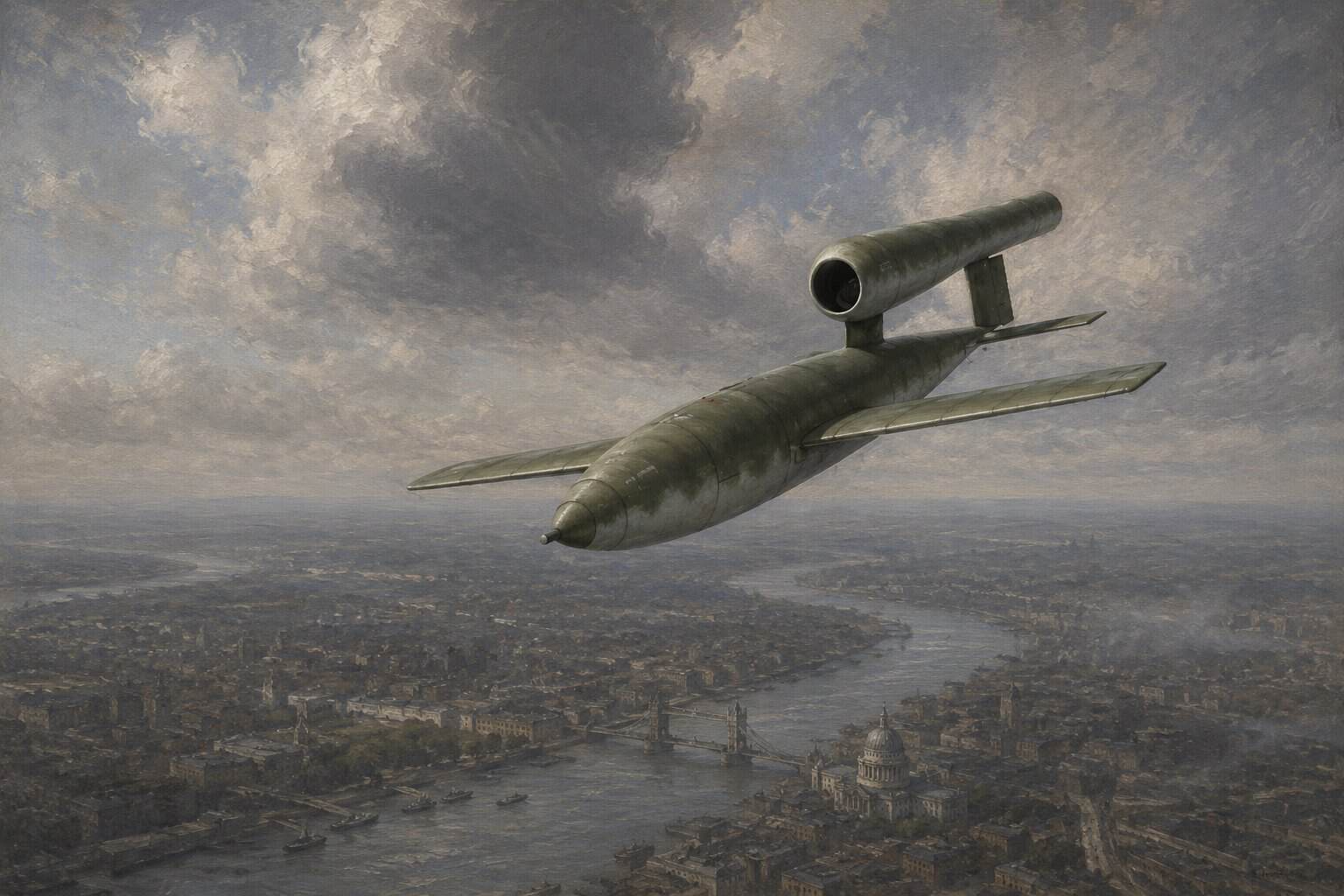
On 13 June 1944, the first V-1 flying bombs were launched against London. Only a handful reached the capital that day, yet the significance of the moment was unmistakable: Britain was now under attack from a new form of weapon, pilotless, mechanically simple in concept and intended to terrorise as much as to destroy. For the Royal Air Force and Britain’s wider air defence system, this was the start of a new contest in which speed, coordination and technical adaptation became decisive.
A new kind of threat
The V-1 was not a bomber in the conventional sense. It carried no crew, followed a preset course and relied on its pulse-jet engine to drive it towards its target. To those on the ground, its sound became part of the psychological effect. People learned to dread the moment when the engine note stopped, because that silence often meant the weapon was descending. The first attacks carried a shock beyond their immediate physical damage. They announced the arrival of an automated offensive that bypassed many of the assumptions shaped by the earlier bomber war.
The new threat emerged only a week after the Normandy landings. Germany could no longer command the air over Britain in the way it had tried to do in 1940, but the V-1 offered another means of striking London and the south-east. It was cheaper than sending manned bomber formations and, from the German point of view, hard to stop in large numbers if launched persistently.
The RAF and Britain’s response
Britain’s defence against the V-1 quickly became known as Operation Diver. It was not a single RAF effort, but a coordinated air-defence campaign involving fighter aircraft, anti-aircraft guns, barrage balloons, radar control, and constant organisational adjustment. In the early phase, fighters played a particularly visible role, chasing down the flying bombs and destroying them over the coast or countryside before they could reach dense urban areas.
This demanded a different sort of interception from the one associated with the Battle of Britain. Pilots were not engaging enemy crews in manoeuvring combat. They were racing against a small, fast, unmanned target on a near-straight course. Success depended on height, speed, position and rapid recognition. The task was dangerous in its own right, and air defence doctrine had to evolve quickly as commanders worked out where to place guns and how best to layer the defences.
Why 13 June 1944 matters
The first day of the offensive did not bring the full scale of what was to follow, but it revealed the character of the campaign ahead. Thousands more V-1s would be launched before the threat was beaten down by a combination of interception, improved gun defences and the Allied advance over the launch areas in France and the Low Countries.
For RAF history, 13 June 1944 marks the start of a new defensive campaign in which speed, control and technical adaptation mattered as much as individual combat. The first V-1s that reached London did not decide the campaign, but they forced Britain to devise a fresh answer to a new kind of air threat.