On This Day, 1940: On 6 October 1940, the Battle of Britain entered its final phase as Luftwaffe attacks shifted from daylight…
Read the entry →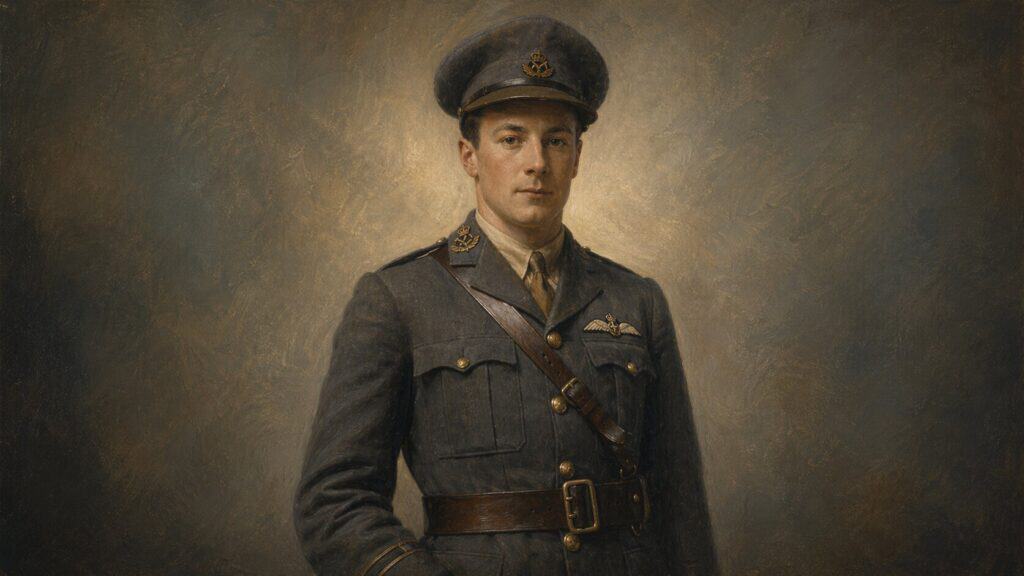
Flight Lieutenant
Alan Jerrard
Alan Jerrard VC was a First World War fighter pilot whose action over Italy made him one of the earliest figures linked to RAF history.
Early Life
Alan Jerrard was born in Lewisham, London, on 3 December 1897. In childhood, he moved with his family to Sutton Coldfield after his father became headmaster of Bishop Vesey's Grammar School, and he later attended Oundle School and Birmingham University. Like many of the young officers who entered military service in the later stages of the First World War, he came from a background that combined conventional education with the expectation of public duty.
Entry into Service
Jerrard first volunteered for the British Army and served with the 5th South Staffordshire Regiment. In 1916, he transferred to the Royal Flying Corps, where he trained as a fighter pilot at a time when air fighting was becoming increasingly specialised and dangerous. By mid-1917, he was serving with No. 19 Squadron in France. His early operational career was interrupted on 5 August 1917 when he was injured in an air crash while flying a SPAD VII, but he returned to duty and resumed active service.
Operational Career
On 22 February 1918, Jerrard joined No. 66 Squadron on the Italian Front, flying the Sopwith Camel. Air operations in Italy demanded aggressive low-level flying against enemy aircraft, balloons and aerodromes, often over difficult ground and in rapidly changing weather. Between 27 February and 21 March 1918, he was credited with four aerial victories, including the destruction of an observation balloon. Although not one of the highest-scoring fighter aces of the war, he had already shown the combination of determination and nerve that marked out effective front-line pilots.
Jerrard's best-known service came in the closing days of the Royal Flying Corps and the opening days of the Royal Air Force. His squadron, like the wider British military air arm, stood on the institutional boundary between the old service and the new one created on 1 April 1918. That timing has shaped how he has been remembered since.
Major Actions or Commands
On 30 March 1918, near Mansuè in Italy, Jerrard flew on offensive patrol with Peter Carpenter and Harold Ross Eycott-Martin. The patrol engaged enemy aircraft and then pressed home a low attack against an aerodrome where further machines were landing or attempting to take off. According to the Victoria Cross citation, Jerrard continued attacking at extremely low height, turned repeatedly to assist a fellow officer in difficulty, and only withdrew when ordered to do so. Even then, he kept turning back against pursuing enemy aircraft until he was finally forced down.
He was captured after the action. Later research into Austro-Hungarian records has added nuance to the exact tally of aircraft destroyed during the fight, and Jerrard himself does not appear to have made exaggerated claims for what he achieved. The distinction for which he is remembered rests less on a clean numerical score than on the conspicuous courage shown in a prolonged and highly exposed combat. His Victoria Cross was gazetted on 30 April 1918, after the formation of the Royal Air Force, and he is therefore often described as the first RAF officer to receive the decoration.
He remains the only Sopwith Camel pilot to have been awarded the Victoria Cross. That fact alone explains part of his enduring interest, but it is the combination of aggression, loyalty to other pilots in combat and readiness to press an attack beyond the point of safety that fixed his place in British air-service history.
Later Life and Death
Jerrard remained a prisoner of war until the end of 1918, when he escaped and reached Allied lines. In 1919, he served in Russia, part of the confused and often overlooked military commitments that followed the Armistice. He stayed in the Royal Air Force as a career officer and eventually retired in 1933 with the rank of flight lieutenant.
He died on 14 May 1968 at Lyme Regis, England. Unlike some more public air figures of the period, he did not become widely known through high command or political prominence, and much of his later reputation continued to rest on the events of 1918.
Historical Significance
Alan Jerrard's historical importance lies in what his career represents about the transition from the Royal Flying Corps to the Royal Air Force. He was not remembered chiefly as a senior commander, theorist or post-war public figure. Instead, his place in RAF history rests on a short but sharply defined record of front-line fighting and on one of the most dramatic individual actions associated with British military aviation in the First World War.
His reputation has also endured because it illustrates the character of air combat on the Italian Front, a theatre often overshadowed by the Western Front in British memory. Jerrard's service shows how small-scale patrol actions, low-level aerodrome attacks and personal initiative could still carry strategic and symbolic weight. His Victoria Cross, gazetted in the first month of the RAF's existence, linked the traditions of the wartime flying services directly to the new independent air arm that followed.
| Dates | Role | Unit | Aircraft |
|---|---|---|---|
| 1916 | Officer | 5th South Staffordshire Regiment | |
| Mid 1917 | Fighter pilot on active service | No. 19 Squadron RFC, France | SPAD VII |
| February 1918 - late 1918 | Fighter pilot | No. 66 Squadron RFC / RAF, Italy | Sopwith Camel |
| 1919 | RAF officer on service in Russia | Royal Air Force | |
| 1919-1933 | Career RAF officer; retired as a flight lieutenant | Royal Air Force |
Jerrard is remembered less for a long public career than for a single episode of extraordinary combat gallantry at a moment of institutional change. His Victoria Cross, gazetted weeks after the RAF was created, gave him a lasting place in the service's early story, while his status as the only Sopwith Camel pilot to receive the decoration has kept his name in specialist aviation history as well as wider military remembrance.
Alan Jerrard VC Awarded for Gallantry over Italy in 1918
On 30 March 1918, Lieutenant Alan Jerrard received the Victoria Cross for gallantry over Italy while…
30 March 2026 · 3 minRoyal Flying Corps Begins the Move to France in 1914
On 12 August 1914, the Royal Flying Corps began moving to France with the BEF, opening…
12 August 2026 · 3 minAmiens Offensive Air Support: RAF Action in August 1918
On 8 August 1918, Amiens Offensive air support saw RAF aircraft attack roads, bridges and communications…
8 August 2026 · 3 min