On This Day, 1939: On 21 October 1939, 46 Squadron Hurricanes intercepted Heinkel He 115 floatplanes over the North Sea in the…
Read the entry →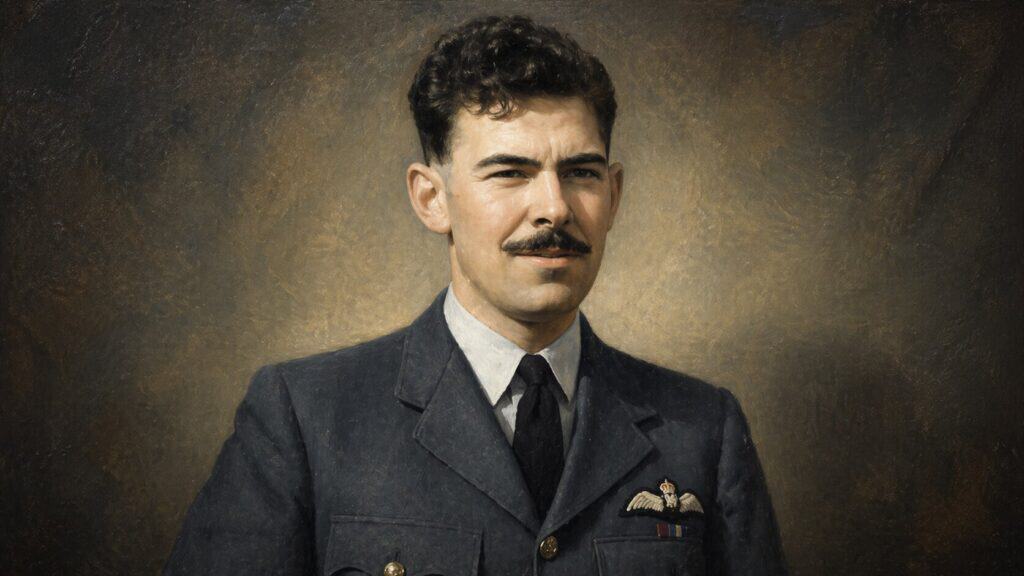
Flight Lieutenant
John Alexander Cruickshank
John Cruickshank VC was a Coastal Command Catalina pilot whose July 1944 attack on a German U-boat became one of the RAF's most remarkable VC actions.
Early Life
John Alexander Cruickshank was born in Aberdeen on 20 May 1920 and was educated in Scotland before entering banking as a young man. Like many of his generation, he had his early adulthood shaped by the approach of another major European war. Before becoming known for one of the most remarkable Victoria Cross actions of the Second World War, he was a Territorial soldier and then an airman whose route into operational service was gradual rather than spectacular.
Entry into Service
Cruickshank joined the Royal Artillery in May 1939, shortly before the outbreak of war, and remained there until 1941. He then transferred to the Royal Air Force Volunteer Reserve and trained as a pilot in Canada and the United States, earning his wings in July 1942. Commissioned from the ranks, he later joined No. 210 Squadron RAF, a Coastal Command flying-boat unit operating Consolidated Catalina aircraft from RAF Sullom Voe in Shetland.
Operational Career
With 210 Squadron, Cruickshank flew long-range maritime patrols over northern waters during the Battle of the Atlantic. These sorties were demanding, often monotonous, and frequently dangerous, requiring crews to search vast areas of sea for U-boats while also protecting convoys and supporting wider naval operations. Coastal Command's work rarely carried the public profile of Fighter Command or the main bomber offensive, but it was essential to the defence of Britain's sea communications and to the larger Allied war effort.
Cruickshank's service placed him in that hard and often overlooked campaign. Flying the Catalina, he operated in conditions where weather, range, navigation and exposure could all be as dangerous as enemy action. His squadron's work formed part of the RAF's sustained pressure on German submarines in the North Atlantic and adjacent waters.
Major Actions or Commands
On 17 July 1944, while flying a patrol intended to help protect the return of the Home Fleet from Operation Mascot, Cruickshank sighted a German U-boat on the surface in northern waters. He immediately attacked. His first run failed when the depth charges did not release, depriving him of the element of surprise and leaving his aircraft exposed to concentrated anti-aircraft fire. Rather than break off, he turned and attacked again.
The second run brought intense and accurate fire. Cruickshank's Catalina was repeatedly hit, his navigator was killed, and several other crew members were wounded. Cruickshank himself was struck in dozens of places and suffered grave injuries, including wounds to his lungs and legs. Even so, he pressed the attack home and successfully released his depth charges, sinking the submarine. The Victoria Cross citation identified the boat as U-347, while later historical research has suggested that the submarine destroyed may instead have been U-361. That uncertainty has not altered the substance of the action for which he was decorated.
Cruickshank then faced a second ordeal: getting the damaged flying boat and its surviving crew back to base. He refused morphine because he believed it might impair his judgement, made sure the aircraft was under control and that the necessary signals had been sent, and continued to direct the return despite repeated lapses into unconsciousness caused by blood loss. After the Catalina reached home waters, he resumed control at a critical stage because he judged the conditions too difficult for a less experienced pilot to attempt the landing safely. The aircraft was brought down successfully at Sullom Voe. His wounds were so severe that he did not fly in command again.
For this action, he received the Victoria Cross, announced in September 1944. The award recognised not simply the destruction of the submarine, but also the steadiness, judgement and endurance he showed after being severely wounded and while responsible for the survival of the rest of his crew.
Later Life and Death
Cruickshank remained in the RAF until 1946 before returning to civilian life in banking. In later years, he became a figure of quiet distinction rather than of public self-promotion, his name chiefly remembered for the Victoria Cross and for Coastal Command history. Decades after the war it was also established that he had long been due the Air Efficiency Award, which was finally presented in 2024.
He lived to the age of 105 and died on 9 August 2025. By the end of his life, he had become the last surviving recipient of a Victoria Cross awarded for service in the Second World War.
Historical Significance
John Cruickshank's place in RAF history rests on more than a single dramatic citation. His story stands for the harsh reality of Coastal Command's anti-submarine war, in which endurance, navigation, seamanship in the air and immediate tactical judgement all mattered as much as attacking skill. His Victoria Cross is also a reminder that some of the RAF's most exacting service was carried out far from the better-known air battles over Europe.
He is remembered as a courageous and disciplined officer whose finest hour came in defence of a wider maritime campaign on which Britain's survival depended. The continued discussion over the exact identity of the submarine sunk on 17 July 1944 also illustrates a broader historical truth: wartime records can be uncertain, while the courage required in the moment is not.
| Dates | Role | Unit | Aircraft |
|---|---|---|---|
| May 1939-summer 1941 | Gunner | Royal Artillery | |
| Summer 1941-July 1942 | Pilot trainee | Royal Air Force Volunteer Reserve | |
| March 1943-1946 | Maritime patrol pilot | No. 210 Squadron RAF, RAF Coastal Command | Consolidated Catalina |
Cruickshank is remembered both for individual gallantry and for what his action reveals about Coastal Command's war against the U-boat threat. His Victoria Cross kept his name in public memory, but his wider significance lies in the way his story draws attention to the long, dangerous patrol war flown from remote bases in defence of Atlantic and Arctic sea routes.
Before his death he was also the last surviving recipient of a Victoria Cross awarded for service in the Second World War, which gave his name an added public resonance in later life. The continuing debate over whether the submarine destroyed on 17 July 1944 was U-347 or U-361 further shows the difference between wartime reporting and later historical reconstruction, without diminishing the substance of his achievement.

RAF Coastal Command and the Battle of the Atlantic
How RAF Coastal Command used patrol aircraft, radar and anti-submarine tactics to help secure Britain’s Atlantic…
18 April 2026 · 5 minVictoria Cross in RAF Service: Gallantry and Memory
A documentary history of the Victoria Cross in RAF service, examining wartime gallantry, operational context and…
7 July 2026 · 4 minOperations Birdcage and Mastiff Aid POW Camps, 1945
On 26 August 1945, RAF aircraft began Birdcage and Mastiff, bringing leaflets, medical teams and relief…
26 August 2026 · 3 min