On This Day, 1939: On 21 October 1939, 46 Squadron Hurricanes intercepted Heinkel He 115 floatplanes over the North Sea in the…
Read the entry →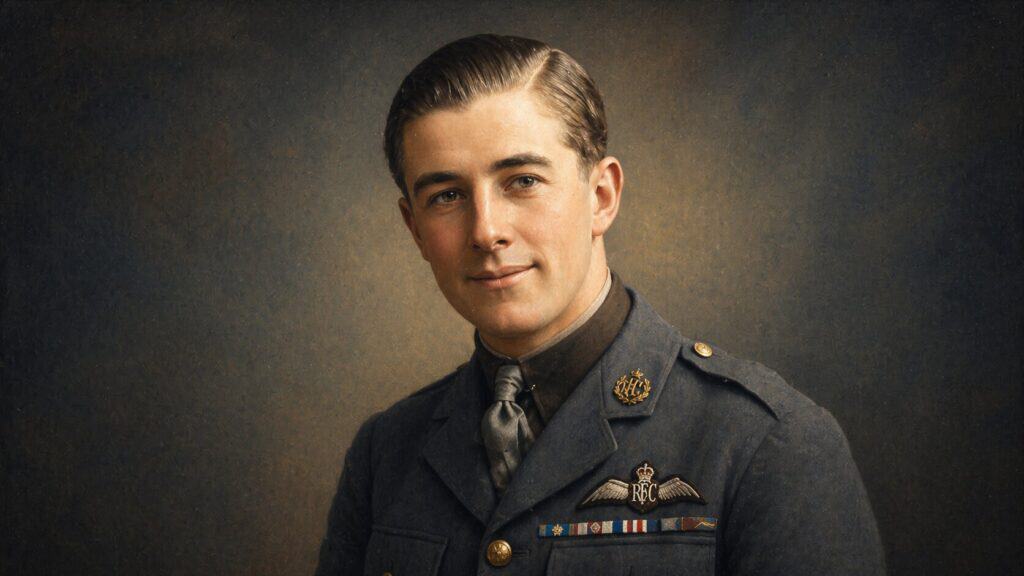
Major
James McCudden
James McCudden VC rose from air mechanic to major, becoming one of Britain's most decorated First World War fighter aces before his death in 1918.
Early Life
James Thomas Byford McCudden was born at Gillingham in Kent on 28 March 1895, the son of a Royal Engineers family whose life was closely tied to military service. His father, William McCudden, had served for many years as a soldier and instructor, and the household combined modest security with strong habits of discipline, technical skill and self-improvement. Those influences mattered. McCudden grew up with an unusual interest in machinery and with an early fascination for the new world of flight, at a time when powered aviation was still a recent and uncertain craft.
He was not shaped by privilege or a conventional officer upbringing. Instead, his route into flying began through engineering and practical trade knowledge. That background later set him apart from many contemporaries. McCudden thought about aircraft not only as fighting machines but as mechanical systems whose reliability, performance and handling could be studied, improved and exploited in combat.
Entry into Service
He joined the Royal Engineers in 1910 and served first as a sapper, including a period in Gibraltar. By 1913, he had qualified as an air mechanic and transferred into the Royal Flying Corps, where he was posted to Farnborough and then to No. 3 Squadron. There, he built a reputation as a capable mechanic, taking every opportunity to understand aircraft both in the air and on the ground. Before the war he had already accumulated practical flying experience, though he remained outside the commissioned flying elite.
When war began in 1914, McCudden went to France with No. 3 Squadron as a mechanic and increasingly flew as an observer. That experience gave him firsthand insight into reconnaissance flying and the realities of air operations over the Western Front before he qualified as a pilot. In 1916, he undertook formal pilot training with No. 41 Squadron and the Central Flying School at Upavon, gained his certificate, and briefly served as an instructor. His advance was rapid, but it rested on technical discipline rather than showmanship.
Operational Career
In August 1916, McCudden joined No. 29 Squadron RFC and began flying the Airco DH.2 in combat. He scored his first confirmed aerial victory on 6 September 1916 and became an ace in February 1917. Even in this early phase, his style was marked by patience, accurate shooting and careful attention to the condition of his machine. He studied gunnery, engine behaviour, sighting, and maintenance systematically, and he became known for turning technical understanding into operational advantage.
After this first period at the front, he returned to England, where he instructed and flew home-defence duties. That service did not carry the glamour later associated with his name, but it was an important part of his development. He flew aircraft such as the Bristol Scout and Sopwith Pup, refined his views on air fighting, and absorbed lessons that would define his later success.
McCudden returned to the Western Front in 1917 with No. 56 Squadron, flying the S.E.5a. It was there that he became one of the outstanding British fighter pilots of the war. During the latter half of 1917 and the opening months of 1918, he steadily increased his score, often claiming more than one victory in a day and repeatedly demonstrating the advantages of disciplined attack methods over reckless aggression. By the time of his death, he had been credited with 57 aerial victories, placing him among the highest-scoring British and Empire aces of the war.
Major Actions or Commands
McCudden's importance rested on more than his tally. He was one of the most technically minded fighter pilots of the First World War and approached combat with an engineer's eye. He paid close attention to engine tuning, gun harmonisation, cockpit arrangement and the need to understand the strengths and limits of a particular aircraft. In an era when many pilots were killed by mechanical weakness, poor training or overconfidence, McCudden represented a more exacting and professional form of air fighting.
His run of decorations reflected that record. He received the Military Medal, the Military Cross and Bar, the Distinguished Service Order and Bar, the French Croix de Guerre, and finally the Victoria Cross for sustained gallantry and success in aerial fighting between August 1917 and March 1918. By early 1918, he had become one of the best-known airmen in Britain, though he appears to have viewed parts of that public attention with reserve.
In 1918, he was posted to the No. 1 School of Aerial Fighting at Ayr, where he flew the Sopwith Snipe, and was later given command of No. 60 Squadron. That appointment suggested how highly he was regarded within the service. He had risen from air mechanic to major and prospective squadron commander in less than a decade, an exceptional progression in wartime aviation.
Later Life and Death
McCudden did not have a substantial later life beyond the war. In July 1918, while returning to France to take up command of No. 60 Squadron, he was killed when his aircraft crashed after engine failure on take-off at Auxi-le-Château. He was 23 years old. His death came at a moment when his reputation, his promotion and his published recollections all pointed to an even larger post-war place in British aviation.
He was buried at Wavans British Cemetery in France. His memoir, published as Flying Fury, helped preserve both his personal account of aerial warfare and his reputation as a thoughtful rather than merely flamboyant fighter pilot.
Historical Significance
James McCudden occupies an important place in British air history because he embodied the transition from improvised early-war flying to a more mature and methodical form of fighter operations. He was not remembered chiefly for theatrical legend, but for the combination of mechanical intelligence, tactical self-discipline and combat effectiveness that made him one of the Royal Flying Corps' most formidable airmen.
His career also carried symbolic weight for the later Royal Air Force. McCudden was a product of technical service rather than social privilege, and his rise from enlisted mechanic to major demonstrated the opportunities created by rapid wartime expansion in military aviation. For historians, his memoir and combat record remain valuable not simply as evidence of personal bravery, but as a window into how fighter warfare was learned, professionalised and remembered in the final years of the First World War.
| Dates | Role | Unit | Aircraft |
|---|---|---|---|
| 1910–1913 | Sapper and air mechanic | Royal Engineers | |
| 1913–1916 | Mechanic, later observer airman | No. 3 Squadron RFC | Blériot aircraft; Royal Aircraft Factory B.E.2c |
| 1916 | Pilot trainee and instructor | No. 41 Squadron RFC and Central Flying School | Farman MF.7; Avro 504; Airco DH.1 |
| 1916–1917 | Fighter pilot | No. 29 Squadron RFC | Airco DH.2 |
| 1917 | Instructor and home-defence pilot | 6th Training Wing and Dover | Bristol Scout; Sopwith Pup |
| 1917–1918 | Flight commander and fighter ace | No. 56 Squadron RFC / RAF | S.E.5a |
| 1918 | Instructor | No. 1 School of Aerial Fighting, Ayr | Sopwith Snipe |
| 1918 | Squadron commander-designate | No. 60 Squadron RAF | S.E.5a |
McCudden is remembered not simply as a high-scoring ace, but as one of the most technically intelligent fighter pilots produced by the RFC. His reputation rests on the combination of combat success, methodical aircraft knowledge and the account he left in *Flying Fury*, which helped shape later understanding of First World War air fighting. Unlike some air-war reputations built mainly on legend, his standing is closely tied to a well-documented operational record and to the unusual rise from enlisted mechanic to major and squadron commander-designate.
James McCudden Awarded the Military Cross in March 1917
On 12 March 1917, James McCudden received the Military Cross, recognising a pilot whose skill and…
12 March 2026 · 3 minAllied Air Power Helps Breach the Hindenburg Line in 1918
By 30 September 1918, Allied air power was helping breach the Hindenburg Line through reconnaissance, artillery…
30 September 2026 · 3 minClive Collett Makes the First British Service Parachute Jump
On 13 January 1917, Captain C. F. Collet made the first parachute jump by a British…
13 January 2026 · 3 min