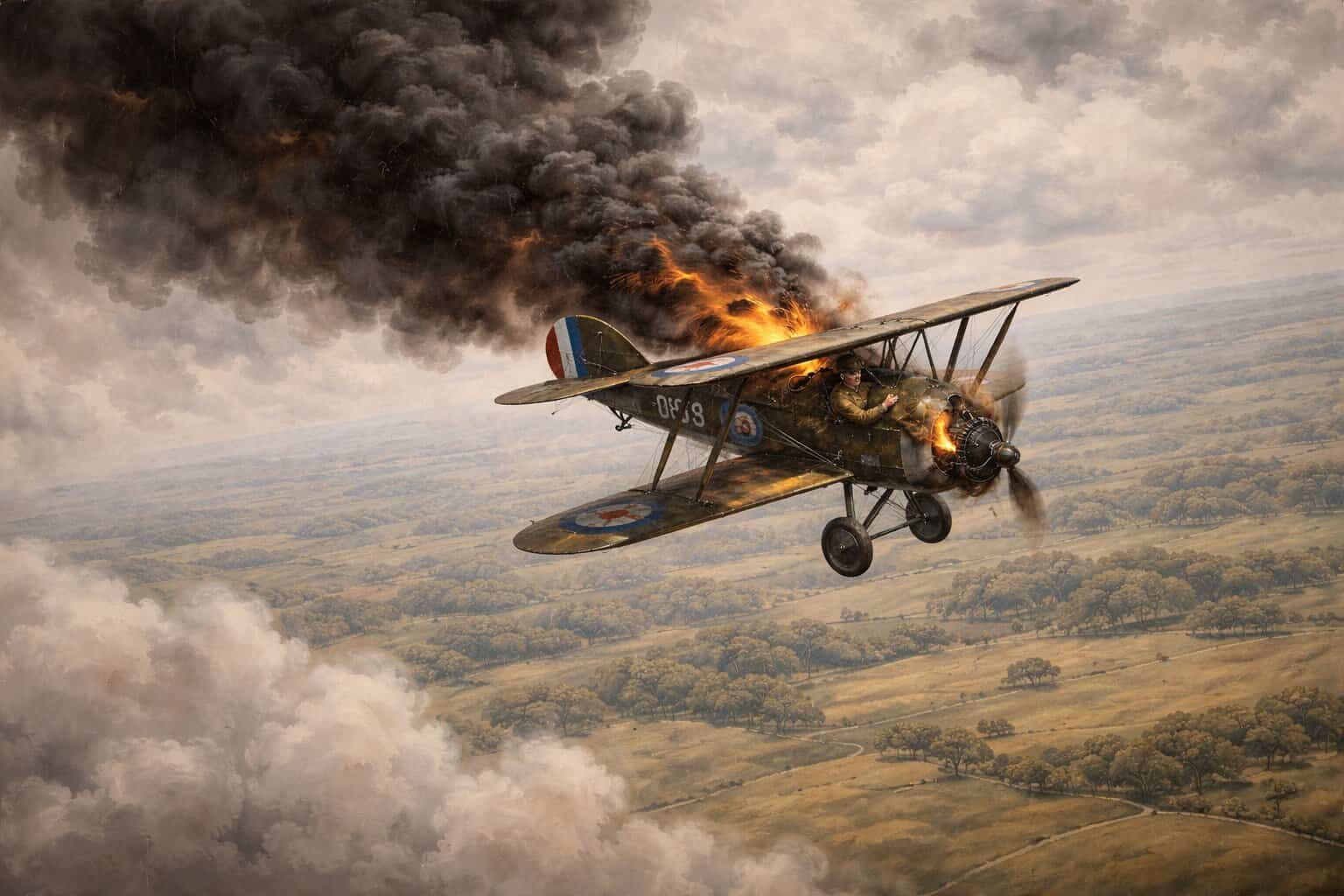
On 9 July 1918, Major James McCudden VC, one of Britain’s greatest First World War fighter aces, was killed in a flying accident at Auxi-le-Chateau in France. The news came as a severe blow to the Royal Air Force, only months after its formation, for McCudden had become one of the best-known and most admired airmen of the war. His death was especially bitter because it did not come in combat with an enemy aircraft, but in an operational flying accident while returning to duty.
A leading ace of the Royal Flying Corps and RAF
McCudden had risen by talent, discipline and technical skill. Unlike some early aviators whose reputations were shaped by dash alone, he was widely respected for methodical flying, careful maintenance, knowledge and an exceptional understanding of aerial gunnery. Those qualities helped him build a remarkable combat record. By the time of his death, he had been credited with 57 victories and had become one of the most highly decorated airmen in British service.
His name was closely associated with No. 56 Squadron and with the S.E.5a, one of the outstanding British fighters of the war. In that combination of pilot, unit and aircraft, McCudden had helped define the maturing professionalism of British air fighting on the Western Front. He represented a generation of airmen for whom combat in the air was becoming a disciplined and increasingly technical form of warfare rather than an improvised duel.
The fatal crash
In July 1918, McCudden was on his way to take up a new command when disaster struck shortly after take-off from Auxi-le-Chateau. His aircraft suffered engine trouble and crashed. The precise sequence belonged to the hazardous world of early military aviation, where even experienced pilots in proven machines remained vulnerable to sudden mechanical failure and the unforgiving margins of flight near the ground.
That reality is central to understanding the period. Aircraft technology had advanced with extraordinary speed between 1914 and 1918, yet it remained fragile by later standards. Engines could fail, structures could break, and airfields were often rough and improvised. For all the glamour attached to aces, flying service was still deeply dangerous even away from the front line.
Loss to the Service
McCudden’s death mattered for more than statistics. He had become a symbol of what British military aviation could produce: a technically gifted airman, a successful leader, and a decorated fighting pilot whose achievements carried influence throughout the Service. In the young RAF, created only in April 1918, such figures helped give air power a distinct identity and prestige as a distinct arm.
His loss also sharpened the sense that the air war quickly consumed talent. Some of the best-known names of the First World War were lost in combat, while others were taken by accident, exhaustion or mechanical failure. The danger was total and continuous.
The Impact of James McCudden
The death of Major James McCudden stands as a reminder of both achievement and vulnerability. He had mastered one of the most demanding forms of warfare of his time and had earned the Victoria Cross, yet even he could not escape the risks inherent in early flight. His record endures not simply because of the number of victories he scored, but because he embodied the transition of British air fighting into a professional and formidable force. On 9 July 1918, the RAF lost not only an ace but one of its formative figures.