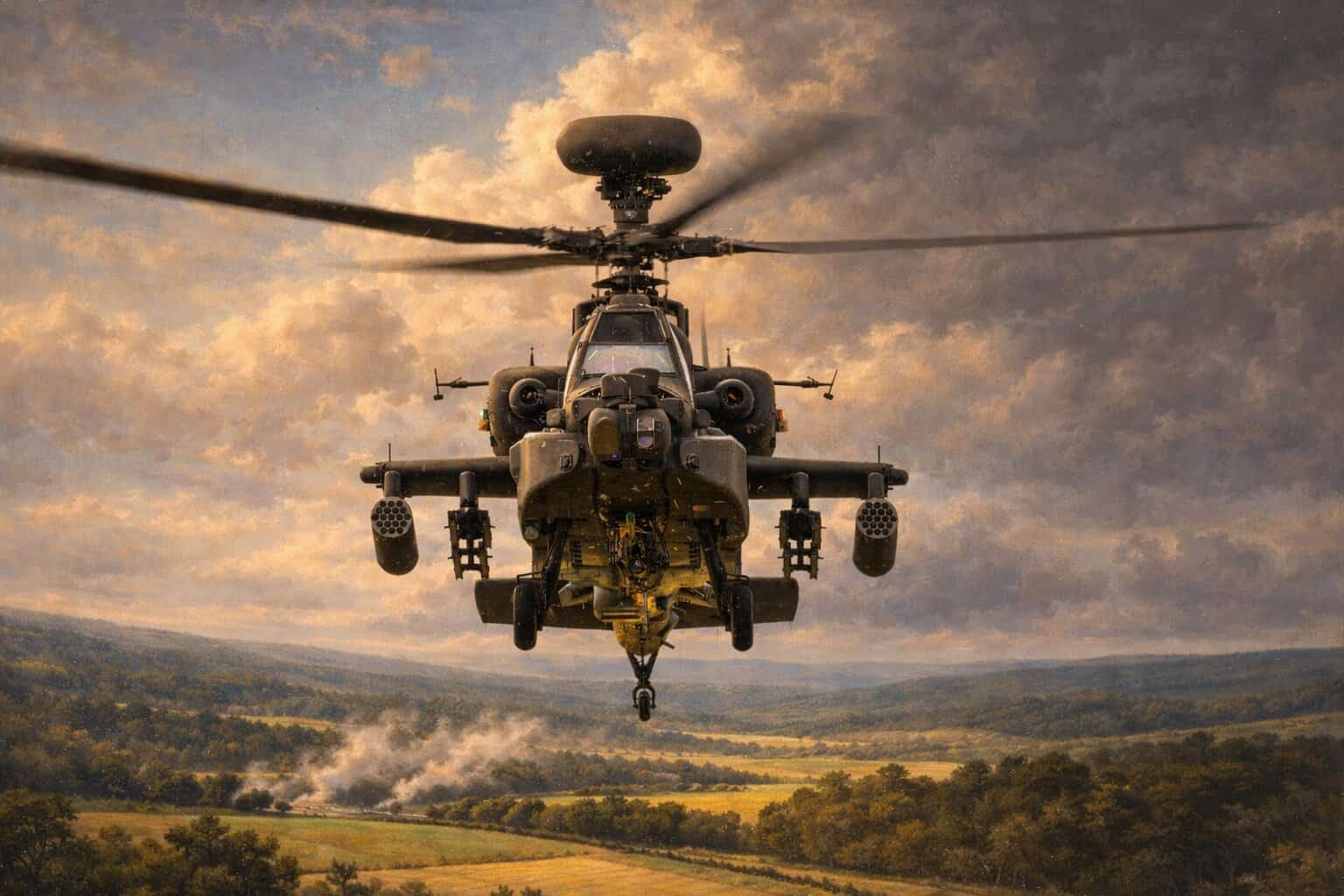
On 15 March 2000, the British Army received the first Westland-built WAH-64 Longbow Apache, marking the beginning of a new attack helicopter capability in British service. Although the aircraft entered the Army Air Corps rather than the Royal Air Force, the milestone still belongs to the wider history of British military aviation and joint air-land operations. It represented the point at which a major procurement programme began to move from planning and production into practical operational use.
The significance of the delivery lay in more than the arrival of a single helicopter. It marked the introduction of an aircraft intended to provide reconnaissance, protection, and precision-strike capabilities in support of ground forces. In the late 1990s and early 2000s, when British defence planning increasingly emphasised mobility, expeditionary operations and joint warfare, that was a major development.
Why the Apache mattered
Attack helicopters occupy a distinctive place in modern warfare. They combine mobility, surveillance and firepower in a form that can move rapidly across a battlefield while remaining closely connected to troops on the ground. For Britain, acquiring the Apache reflected a wider effort to ensure that its armed forces possessed a modern battlefield aviation capability suited to contemporary operations.
By 2000, British defence policy had moved well beyond the static assumptions of the Cold War. Forces were expected to deploy overseas, operate in coalition environments, and respond quickly to evolving crises. In that environment, helicopters became increasingly important. Transport aircraft moved men and materiel, while attack helicopters added a protected, heavily armed layer of tactical support. The Apache answered a clear operational need.
A British-built Apache
This first delivery also mattered because it involved a Westland-built aircraft. That detail connected the new capability not only to front-line service, but also to British industrial participation. Military aviation milestones are rarely only about the user service. They also reflect the relationship between procurement, domestic industry and long-term support.
Building the type in Britain gave the programme broader national significance than a straightforward off-the-shelf purchase would have. It tied the aircraft more closely to British training, maintenance and sustainment systems, and it linked operational capability to the defence-industrial base that would support the type in service. In that sense, the arrival of the first WAH-64 Longbow Apache was both an operational and an industrial event.
Joint relevance beyond one service
The date also matters because British military aviation does not operate in neat service compartments. Modern operations depend on cooperation between the Army, the RAF and the Royal Navy. The arrival of a major new Army helicopter type affected the broader balance of British air capability and how joint operations could be planned and supported.
For the RAF, the growth of advanced battlefield helicopter forces in British service formed part of a broader change in the character of air power. Modern military aviation is not defined only by independent air campaigns. It also includes direct support to land forces, the rapid concentration of combat power and the integration of aircraft into larger operational systems. The Apache’s arrival sat within that wider evolution.
A marker of modernisation
The first Apache delivered on 15 March 2000 stands as a clear marker of modernisation in British military aviation. It announced the start of a new capability and showed how British aviation was adapting to contemporary operational demands. The aircraft would go on to become closely associated with the Army Air Corps, but its importance extended beyond a single branch.
As with many first deliveries, the moment may have seemed administrative at the time. Yet such events often matter most in retrospect, because they show when a capability genuinely begins to enter service life. The arrival of the first Westland-built WAH-64 Longbow Apache was one of those moments, marking the beginning of a new phase in British battlefield aviation and joint operational planning.