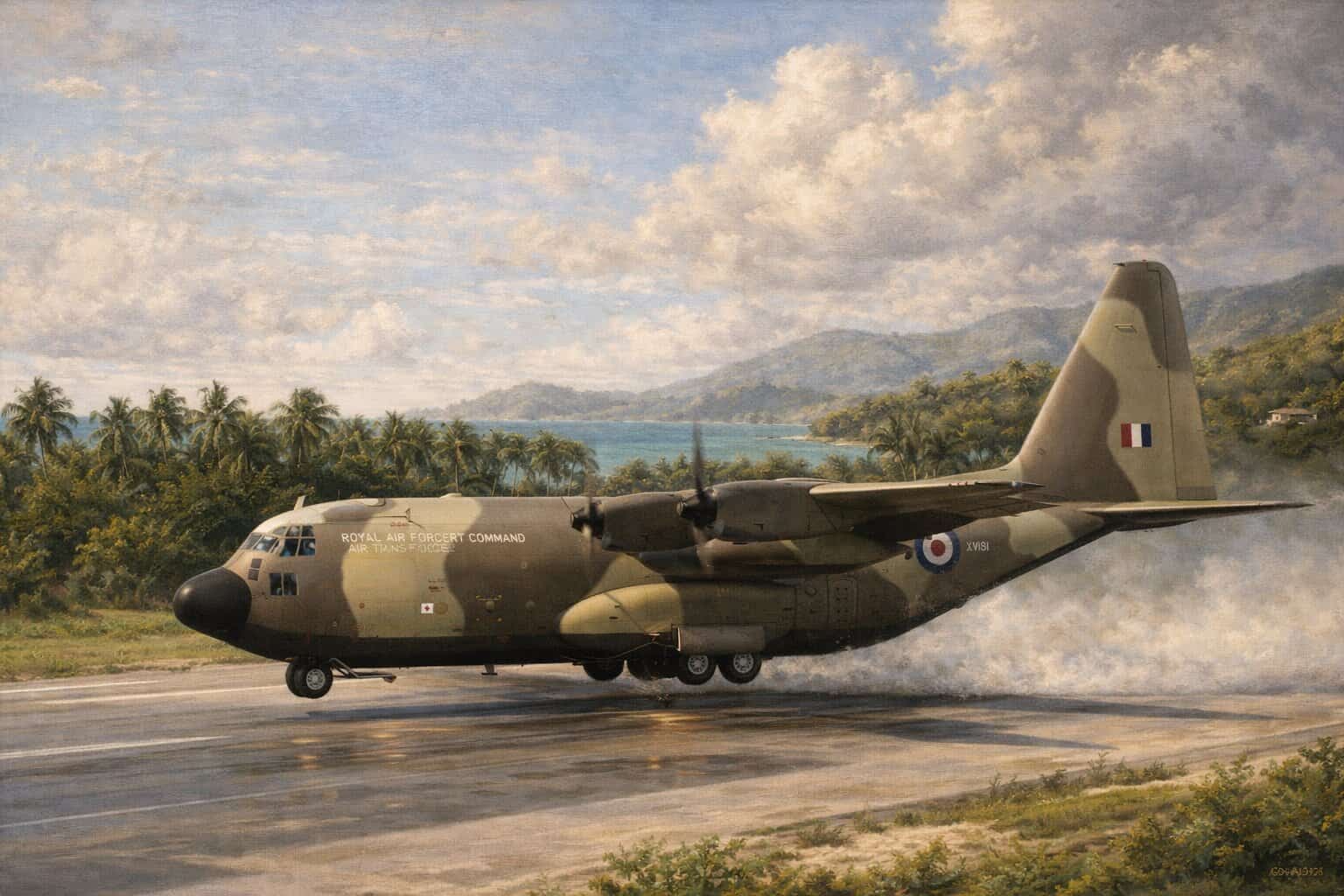
On 18 March 1969, the Royal Air Force became part of the British response to events in Anguilla, where civil unrest and a constitutional dispute had created a tense and uncertain situation.
Between 18 and 19 March, RAF transport aircraft helped airlift around 300 troops to the island. Though small beside the great air campaigns with which the Service is more often associated, the operation showed a different and increasingly important side of post-war air power: speed, reach and the ability to move an organised force at very short notice.
Anguilla’s crisis arose from political tensions within the associated state of St Kitts-Nevis-Anguilla. Many on Anguilla opposed rule from St Kitts and had already challenged the existing settlement. By March 1969, the dispute had become serious enough for the British Government to intervene directly.
In such circumstances, the RAF’s value was immediate. Troops could be assembled, embarked and delivered far more quickly by air than by sea, especially when the priority was to restore order before a local crisis hardened into something more dangerous.
Air mobility in the Cold War era
The Anguilla airlift belongs to a wider Cold War pattern in RAF history. Britain still carried global responsibilities, but the age of maintaining vast permanent garrisons everywhere had passed. Air transport became one of the essential instruments of policy.
Aircraft gave ministers and commanders the means to reinforce distant territories, support allies, move humanitarian aid and demonstrate resolve without the delay that had once been unavoidable. In this sense, Anguilla was not merely a local episode in the Caribbean. It illustrated how the RAF underpinned British power in an era when crises often emerged far from Europe and developed rapidly.
A transport operation might not have the drama of a bombing offensive or a fighter battle, yet it could be just as decisive in practical terms. The success of any intervention depended first on getting people and equipment to the right place, in the right order and at the right time.
A restrained but important intervention
The purpose of the airlift was not conquest but control. The troops carried in by the RAF were intended to stabilise the situation and re-establish British authority. That distinction matters. In many Cold War emergencies, the prompt deployment of disciplined forces could prevent wider disorder and reduce the likelihood of prolonged violence.
Air transport enabled exactly that kind of measured response. The episode also demonstrated the professionalism required in operations that attract less public attention than wartime exploits. Planning had to be swift, loads had to be organised correctly, routes coordinated, and timings maintained.
The RAF’s transport crews and supporting ground personnel made such undertakings possible through routine skill rather than spectacle. Their work was a reminder that military effectiveness often rests on careful execution of tasks that are easily overlooked in retrospect.
Why Anguilla still matters
Seen from a distance, the Anguilla airlift may appear a minor footnote in RAF history. Yet it captures a central truth about the Service in the later twentieth century. The RAF was not only a force for combat in the air; it was also a force for movement, presence and rapid reaction across long distances.
On 18 March 1969, that capability was put to practical use in the Caribbean. The significance of the day lies in what it reveals about the Service’s adaptability. From major war to limited intervention, the RAF remained a national instrument of immediate action.
Anguilla was one of those moments when air power was measured less by destruction than by arrival, and by the speed with which order could be supported from thousands of miles away.