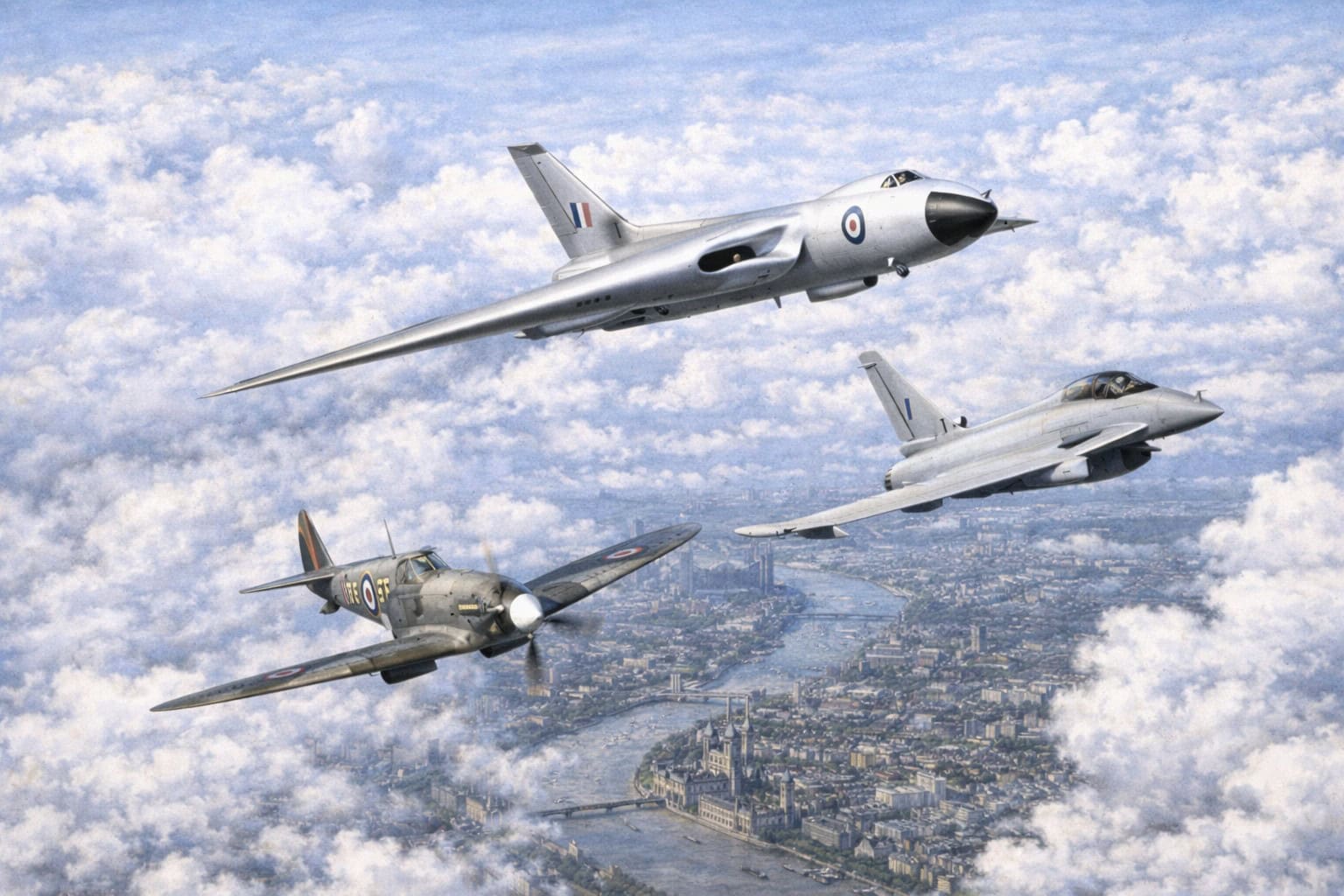
On 1 April 1918 the Royal Air Force came into being through the amalgamation of the Royal Flying Corps and the Royal Naval Air Service. It was a major administrative and strategic change carried out during the final year of the First World War, and it created what is generally recognised as the world’s first independent air force. The new service was established under the Air Ministry, reflecting a belief that air power had developed beyond its earlier supporting role and required its own central direction.
The decision did not emerge in peacetime calm. By 1918 Britain had already seen how quickly military flying had expanded from reconnaissance and artillery observation into bombing, air defence, naval cooperation and offensive operations over the Western Front. Aircraft were no longer an experimental adjunct to older arms. They had become an increasingly important part of how modern war was fought.
Why the New Service Was Created
The merger answered both practical and strategic problems. Before April 1918 Britain’s military aviation had been divided between the Army’s Royal Flying Corps and the Admiralty’s Royal Naval Air Service. Each had developed its own systems, priorities and command arrangements. That separation made sense in the early years of flight, but wartime experience exposed duplication, rivalry and uncertainty over responsibility. German air attacks on Britain, together with the wider demands of industrial warfare, strengthened arguments for a unified approach.
Questions of home defence, aircraft production, training and long-range bombing could not easily be handled by services competing for men, machines and authority. The creation of the RAF was therefore intended to bring coherence to planning and control at a moment when Britain needed to use air power more systematically. Among the senior figures associated with that transition were Hugh Trenchard and Frederick Sykes, whose ideas and administrative experience helped shape the new service.
From Amalgamation to Operational Service
The new force began life in wartime rather than as a theoretical reform. Personnel, aircraft, stations and ongoing operations had to be absorbed into a single service while the conflict continued. That alone was a formidable undertaking. Uniforms, ranks, administration and doctrine all required adjustment, yet the immediate business of war allowed no pause.
The RAF inherited a wide set of responsibilities. It had to support ground operations on the Western Front, defend Britain against air attack, conduct bombing operations, and maintain maritime air work that remained vital to the war effort. In effect, the service was born while already fully engaged. Its foundation was therefore not simply a constitutional milestone but an operational one, because it brought a large and active air arm under independent command at a decisive stage of the war.
Significance of 1 April 1918
The importance of the RAF’s creation lay in more than its novelty. It signalled official recognition that air warfare was not merely a subsidiary branch of land or naval fighting. By giving air power institutional independence, Britain accepted that command of the air, strategic attack and national air defence demanded dedicated thought and organisation. That did not settle every debate.
Inter-service boundaries, the purpose of bombing, and the precise relationship between air, land and sea power would continue to be argued for decades. Even so, 1 April 1918 marked a decisive shift. The RAF’s establishment provided a framework within which those debates would take place, and within which British air doctrine would develop between the wars and beyond.
A Wider Turning Point in Modern War
Seen in the wider history of the air war, the founding of the Royal Air Force represented a turning point in how states understood aviation. The First World War had shown that aircraft could influence events far beyond the battlefield immediately below them. Britain’s response was to create a service designed specifically for that new reality. For that reason, the RAF’s foundation remains one of the most important institutional moments in military aviation history.
On this day in 1918, Britain did not simply rename existing organisations. It created a new instrument of war whose influence would be felt throughout the remainder of the twentieth century.