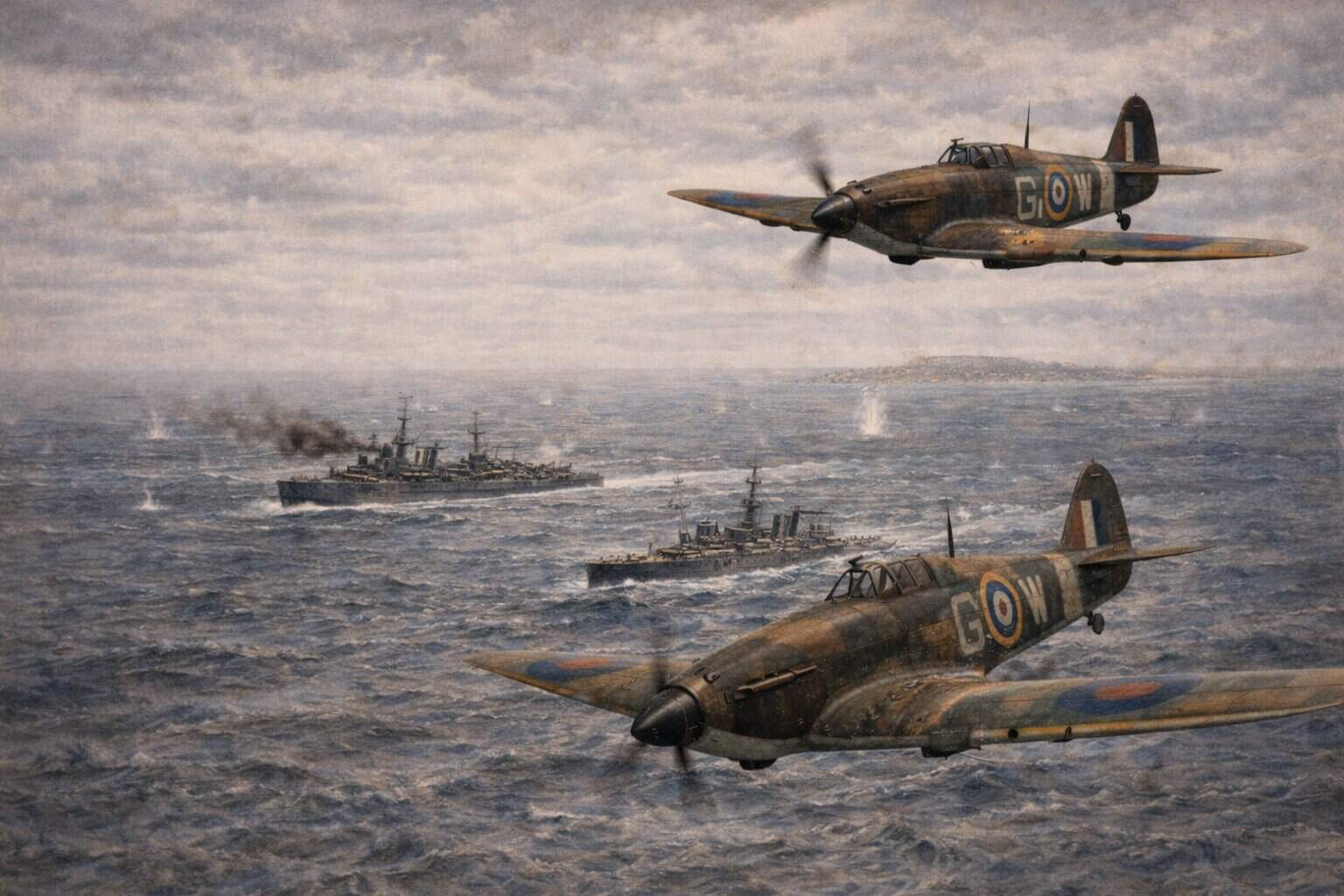
On 8 January 1941, the Mediterranean was in the middle of Operation Excess, a major British effort to push a convoy through to Malta and Greece while the Mediterranean Fleet covered a parallel movement of shipping around Malta itself. Convoy MC.4, escorted by Force H from Gibraltar, and the Mediterranean Fleet’s own covering force from Alexandria were converging on the central Mediterranean, with Malta serving as a destination, staging point and increasingly important British air and naval base.
Operation Excess ran across roughly a week in January 1941 and combined several separate movements: merchant ships bound for Malta and onward to Greece from Gibraltar, a supply convoy from Alexandria to Malta, and the return of empty shipping to Alexandria. Behind it lay a wider strategic problem. Malta and Greece both depended on convoys getting through safely, and the Royal Navy could only manage that by committing some of its most valuable ships to the operation, including the aircraft carrier HMS Illustrious.
Operation Excess and Malta
Malta lay between Sicily and the North African coast, within range of Axis airfields and close enough to Italian naval bases to threaten Axis convoys bound for Libya. Holding and supplying the island was central to British strategy in the Mediterranean theatre, even as resources were also going to the defence of Greece. Operation Excess addressed both needs in a single movement, reinforcing Malta directly while pushing a convoy through to Greek ports.
The forces involved reflected the scale of the task. Force H, based at Gibraltar under Admiral Sir James Somerville, escorted convoy MC.4 eastward from the Atlantic side of the Mediterranean. The main strength of the Mediterranean Fleet, under Admiral Sir Andrew Cunningham and sailing from Alexandria, covered the parallel convoy movement to and from Malta and was to take over responsibility for MC.4 once it reached the central Mediterranean. That covering force included the battleships Valiant and Warspite and the carrier Illustrious, whose Fulmar fighters provided the convoy’s main air defence at sea.
What Happened on 8 January
By 8 January, the separate elements of Operation Excess were converging across hundreds of miles of the central and eastern Mediterranean, each force timed to meet its convoy or hand over escort duties at a fixed point. Italian reconnaissance aircraft had already located the Mediterranean Fleet’s covering force earlier in the operation, so further sightings were expected as the ships moved into more contested waters near Sicily.
The convoy and its escorts were not yet under sustained air attack on 8 January. The following day, ten Italian SM.79s attacked convoy MC.4 and Force H, while the far heavier German assault came on 10 January. The significance of 8 January therefore lay in the convergence of the separate British naval forces as they approached the most dangerous stage of Operation Excess.
The Air Threat Was About to Change
The threat was rising quickly because of Fliegerkorps X, a specialist German air corps that had been transferring from Norway to bases in Sicily since December 1940. Fliegerkorps X had trained extensively in attacks on shipping and flew the Junkers Ju 87 dive-bomber, a far more accurate weapon against fast-moving ships than the high-level bombing the Italian air force had relied on. Its arrival turned the central Mediterranean into one of the most dangerous stretches of water the Royal Navy faced during the war.
Malta’s own air strength at this stage was limited to a small force of Hawker Hurricane fighters, reinforced only gradually through 1940, together with reconnaissance aircraft used to track Axis shipping and aircraft movements. These squadrons gave the island some ability to watch for and respond to raids, but they were not built to meet a large, coordinated Luftwaffe strike at sea. That task fell mainly to the fleet’s own carrier-borne fighters once German aircraft entered the battle.
The Attack on Illustrious
That attack came on 10 January. As the Mediterranean Fleet’s covering force escorted the convoy south of Sicily, Ju 87 Stukas from Fliegerkorps X, supported by Heinkel He 111 bombers, struck in concentrated waves. HMS Illustrious was hit repeatedly, suffering serious damage to her flight deck and hangar and heavy loss of life among her crew. She reached Malta’s Grand Harbour that evening and underwent emergency repairs. HMS Warspite was also hit, though far less severely, and the destroyer Gallant had already been damaged by a mine earlier that day. On the same day, Wellington bombers based on Malta struck the Italian fleet at Naples, damaging the battleship Giulio Cesare and helping to keep the Italian navy’s remaining heavy units in harbour. The following day brought further losses, including the sinking of the cruiser HMS Southampton, before the convoys themselves reached Malta safely. On 16 January the Luftwaffe mounted its first heavy attack on Malta aimed at destroying the damaged carrier, beginning the most intense phase of the so-called Illustrious Blitz.
Why Operation Excess Mattered to RAF Malta
For the RAF on Malta, Operation Excess and its aftermath opened a much harder period. Within days of Illustrious reaching Grand Harbour, the Luftwaffe began a sustained campaign against the island itself, seeking to destroy the crippled carrier before she could be moved to safety. Malta’s fighters, though few in number, were drawn directly into that fight, defending the harbour and the airfields that any future Excess-style convoy would depend on.
Operation Excess showed how closely RAF air defence on Malta, Fleet Air Arm carrier aviation and Royal Navy escort work were now bound together, and it announced the arrival of a German air force capable of hitting that combination hard. As Operation Excess’s separate forces converged on 8 January 1941, they were approaching the first major encounter between a British Mediterranean convoy and the newly arrived German anti-shipping force in Sicily. The fighting of 10 January and the subsequent attacks on Illustrious at Malta marked a sharp escalation in the air threat facing the island.