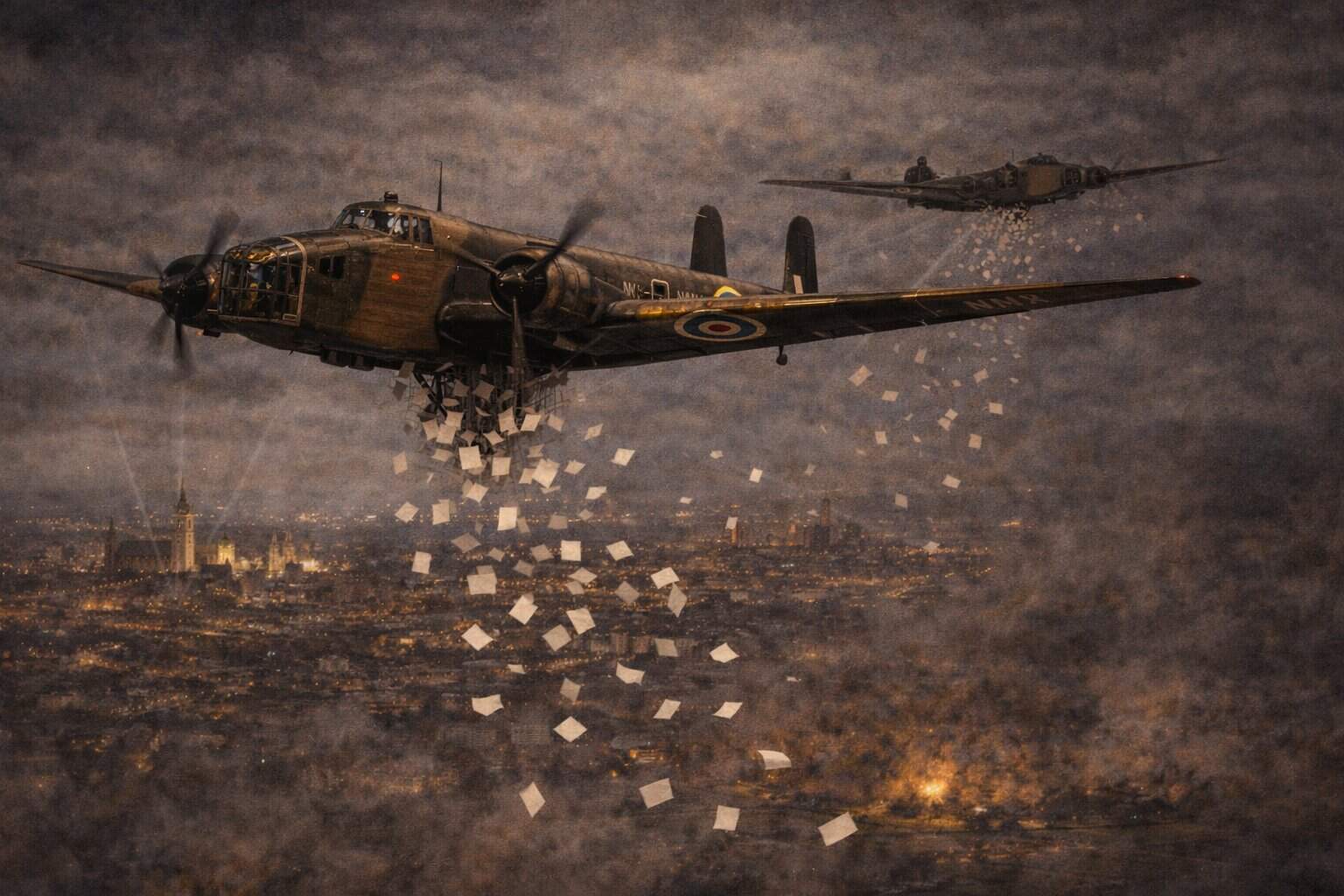
On the night of 12–13 January 1940, Armstrong Whitworth Whitleys of No. 77 Squadron flew from Villeneuve in France and dropped propaganda leaflets over Prague and Vienna for the first time. The operation was part of the RAF’s leaflet campaign during the early months of the Second World War, in the period that became known as the Phoney War, when Britain and France had been at war with Germany for more than four months without full-scale bombing of German cities.
The raid put RAF leaflets over two cities that had only recently come under German control, and it extended a campaign that had already been running for several months from bases in England and France.
Leaflet raids during the Phoney War
By January 1940, the British government had held back from bombing German industrial or urban targets. Ministers were wary of provoking German retaliation against civilian populations in Britain and France, and the early strategic picture called for restraint rather than escalation. Bomber Command’s operations in these months were largely confined to reconnaissance, attacks on naval and military targets, and leaflet drops over Germany and German-occupied territory.
These leaflet sorties were known within the RAF as “Nickel” operations. They had begun in September 1939, within weeks of the declaration of war, and carried printed propaganda material rather than bombs. The material was aimed at German civilian and occupied populations, intended to counter Nazi propaganda and unsettle confidence in the German war effort. The raid on Prague and Vienna in January 1940 was the first Nickel sortie to reach those two cities, adding them to a growing list of targets across Germany and German-controlled Europe.
No. 77 Squadron flies from Villeneuve
No. 77 Squadron flew the Armstrong Whitworth Whitley, a twin-engined medium bomber that had entered RAF service in 1937. Alongside the Vickers Wellington and the Handley Page Hampden, the Whitley formed one of Bomber Command’s three main bomber types at the outbreak of war, and its range made it well suited to long flights over enemy territory.
For the Prague and Vienna operation, the squadron operated from Villeneuve, near Vertus in France, one of the forward airfields used by RAF squadrons supporting operations from French territory during the winter of 1939 to 1940. Flying from a base in France rather than England shortened the distance to targets in central Europe, though reaching Prague and Vienna and returning still meant a long night flight over hostile territory in winter conditions.
Prague and Vienna, 12–13 January 1940
On the night of 12–13 January 1940, Whitleys of No. 77 Squadron crossed German-controlled airspace to reach Prague and Vienna. Both cities lay within territory absorbed into the German sphere over the previous two years. Bohemia and Moravia, including Prague, had come under German occupation in March 1939, and Vienna had been part of the Reich since the Anschluss with Austria in 1938. The choice of targets put RAF propaganda in front of populations recently brought under German rule.
Over both cities the crews released leaflets rather than bombs, in keeping with the RAF’s use of Nickel sorties to carry printed material into enemy and occupied territory without resorting to area bombing. No. 77 Squadron’s Whitleys had dropped leaflets over Prague and Vienna for the first time, though leaflet raids on other German cities and occupied territory had already been flown in the months since September 1939.
What the raid meant for Bomber Command
The Prague and Vienna sortie sat within Bomber Command’s cautious posture during the Phoney War. British policy at this stage avoided attacks on German civilian centres, shaped by concern about retaliation and by a reluctance to widen the air war before land operations had begun in earnest. Leaflet raids gave Bomber Command a way to remain active over enemy and occupied territory while that restraint held, using Whitleys, Wellingtons and Hampdens to carry propaganda rather than high explosive.
For No. 77 Squadron, the operation added Prague and Vienna to the cities reached by RAF leaflet sorties since the previous September. Within months, the character of the air war changed. Germany’s offensive in Western Europe that spring brought the Phoney War to an end, and with it the limited scope of Bomber Command’s early operations. As part of the wider Second World War air campaign, the leaflet raids of the Phoney War mark a distinct early phase, one that gave way within months to the sustained bombing operations that followed.