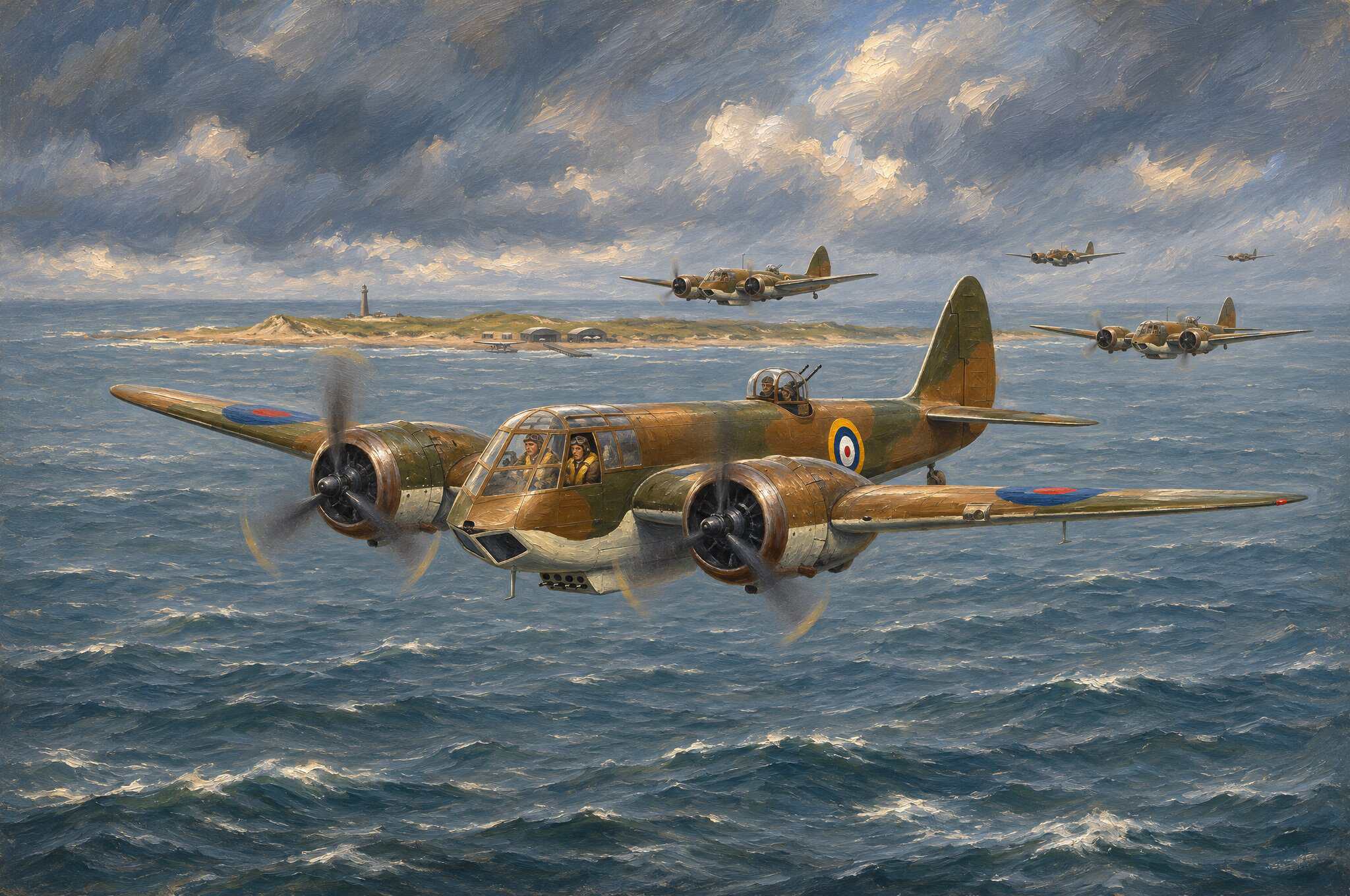
On 28 November 1939, twelve RAF Blenheim fighters crossed the North Sea to attack the German seaplane base at Borkum. Six aircraft from 25 Squadron and six from 601 Squadron took part in the low-level raid. All twelve returned safely. The attack brought Fighter Command aircraft into offensive action against a German coastal installation during the opening months of the Second World War.
The raid’s material results were limited. Its place in the early air war rests on the operation itself: two fighter squadrons combined to strike an enemy base across the North Sea, using an aircraft adapted from a light bomber for long-range fighter duties.
Blenheims in the fighter role
The Bristol Blenheim had entered RAF service as a modern twin-engined bomber in 1937. The development of the longer-nosed Mk IV subsequently released earlier Mk I airframes for other uses. One adaptation was the Blenheim IF, equipped with a pack of four forward-firing .303-inch Browning machine guns beneath the bomb bay.
This armament gave the converted aircraft a concentrated battery for fighter operations. Its twin-engined layout and endurance also offered scope for longer-range work. The Borkum force consisted of these fighter conversions, employed in a low-level attack on the seaplane station.
25 Squadron had begun receiving Blenheim IFs in December 1938, replacing its Demon biplanes. The auxiliary 601 Squadron began its conversion in January 1939. By the outbreak of war, both units were operating an aircraft whose fighter employment was still developing alongside its established bomber role.
The attack on Borkum
Borkum lay off Germany’s North Sea coast, placing its seaplane base within reach of a cross-sea sortie from Britain. The force assembled for the attack drew equally on the two squadrons, bringing twelve Blenheim IFs against a single coastal objective.
The aircraft attacked at low level. Their fighter armament allowed the crews to strafe the seaplane base at low level, using their forward-firing guns during the attack. The operation combined the outward sea crossing, the attack on the station and the return flight to Britain.
The raid caused only slight damage, but all twelve Blenheims returned safely. The immediate outcome was therefore a completed offensive sortie by the entire formation, accompanied by only a modest effect on the target.
A developing role within Fighter Command
The Borkum raid belonged to an early period of experimentation with the Blenheim as a fighter. Its performance imposed limitations in daylight combat, while its capacity to carry bulky airborne interception equipment opened another operational role. During 1939, 25 Squadron was already receiving aircraft equipped with early airborne radar.
The participating squadrons subsequently followed different paths. In March 1940, 601 Squadron completed its conversion to the Hawker Hurricane. For 25 Squadron, night defence became the principal wartime commitment, and Bristol Beaufighters began arriving in October 1940.
Borkum therefore occupies a specific place in their service histories: an early shared offensive operation with Blenheim fighters, preceding those later changes in equipment and employment. The twelve crews brought their aircraft home after a low-level strike on German territory, while the limited damage kept the raid’s operational effect local and contained.