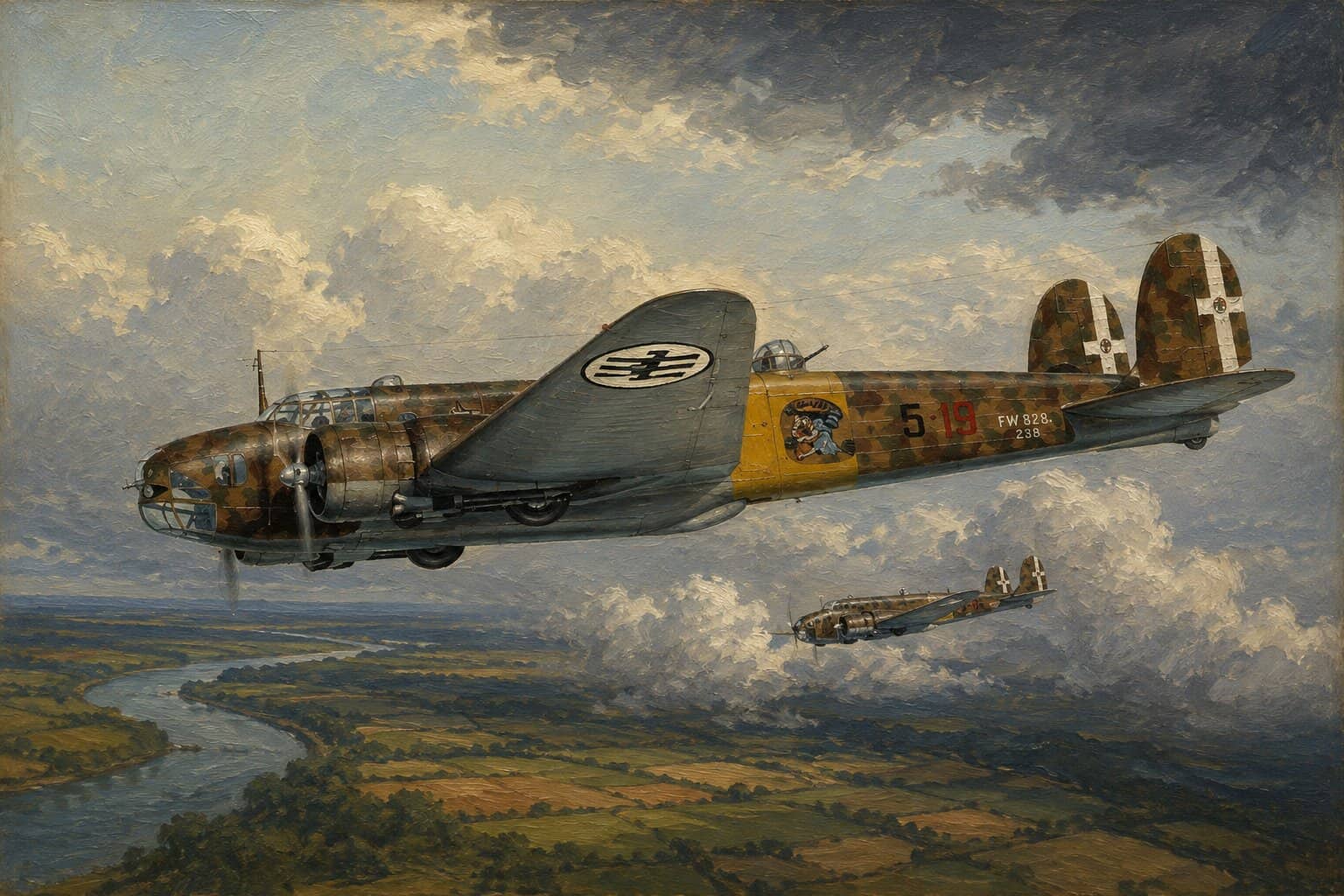
On the night of 24/25 October 1940, Italian bombers operating from Belgium made the Corpo Aereo Italiano’s first raid against Britain, attacking the Harwich area. Fifteen Fiat BR.20 bombers took part in the operation, which brought an Italian expeditionary air force into the campaign against British home defences during the closing days of the Battle of Britain.
The attack opened a small, politically significant contribution to the Axis air offensive. Its immediate results were limited, and the difficulties encountered during the ensuing campaign exposed the gap between Mussolini’s ambitions and the force’s operational effectiveness.
An Italian force in Belgium
Italy had entered the war in June 1940. Expecting an Axis victory, Mussolini sought a visible Italian share in the campaign against Britain and ordered the Regia Aeronautica to establish an expeditionary force. The resulting Corpo Aereo Italiano, or Italian Air Corps, comprised three wings and around 200 aircraft.
Its units operated from Belgian bases including Melsbroek, Chièvres, Maldegem and Ursel. Attached to the Luftwaffe’s Luftflotte 2, the contingent brought Italian crews, aircraft and operating methods into an offensive already shaped by months of combat against the RAF.
Fiat BR.20 bombers formed the striking arm, alongside Fiat CR.42 biplane fighters and Fiat G.50 monoplanes. This mixture gave the contingent both bombing and fighter capabilities, while placing considerable demands on crews adapting to operations from northern Europe. Training, experience and the suitability of aircraft and tactics would all influence the campaign’s results.
The opening attack on Harwich
The first operation sent the BR.20 force across to the Harwich area under cover of darkness. The raid achieved little, although Italian publicity presented the opening attack as a substantial success. Harwich became one of several east-coast places attacked during the contingent’s subsequent operations.
For Britain, the arrival of Italian aircraft added another national contingent to the forces threatening its coast and towns. Fighter Command and the wider home-defence organisation continued to face attacks as the air campaign moved through its autumn phase. The Italian opening raid belonged to this continuing pressure on Britain, with night operations forming an important part of the contingent’s activity.
The attack also established the operational pattern from which the Italian effort developed. A daylight bombing mission against Deal followed on 29 October, and fighters swept over Canterbury on 1 November. These later sorties extended the campaign from the opening night attack into daylight operations over southern England.
A limited campaign against British defences
Italian fighter sweeps along the Channel continued into late November. Bombers operated mainly at night against east-coast targets including Felixstowe, Lowestoft, Ipswich and Harwich. The force’s limited experience and training, together with shortcomings in its equipment and tactics, restricted its effectiveness. Losses accumulated while the damage inflicted remained slight.
The BR.20 bombers and CR.42 fighters returned to Italy in early 1941. A smaller G.50 element remained in Belgium for local coastal patrols until April.
The Harwich raid therefore opened a brief Italian extension of the air offensive against Britain. Fighter Command and Britain’s wider air-defence system now faced an additional Axis contingent during an already sustained campaign. The Italian deployment produced little operational effect, and its withdrawal left the Luftwaffe carrying the principal burden of the continuing offensive.