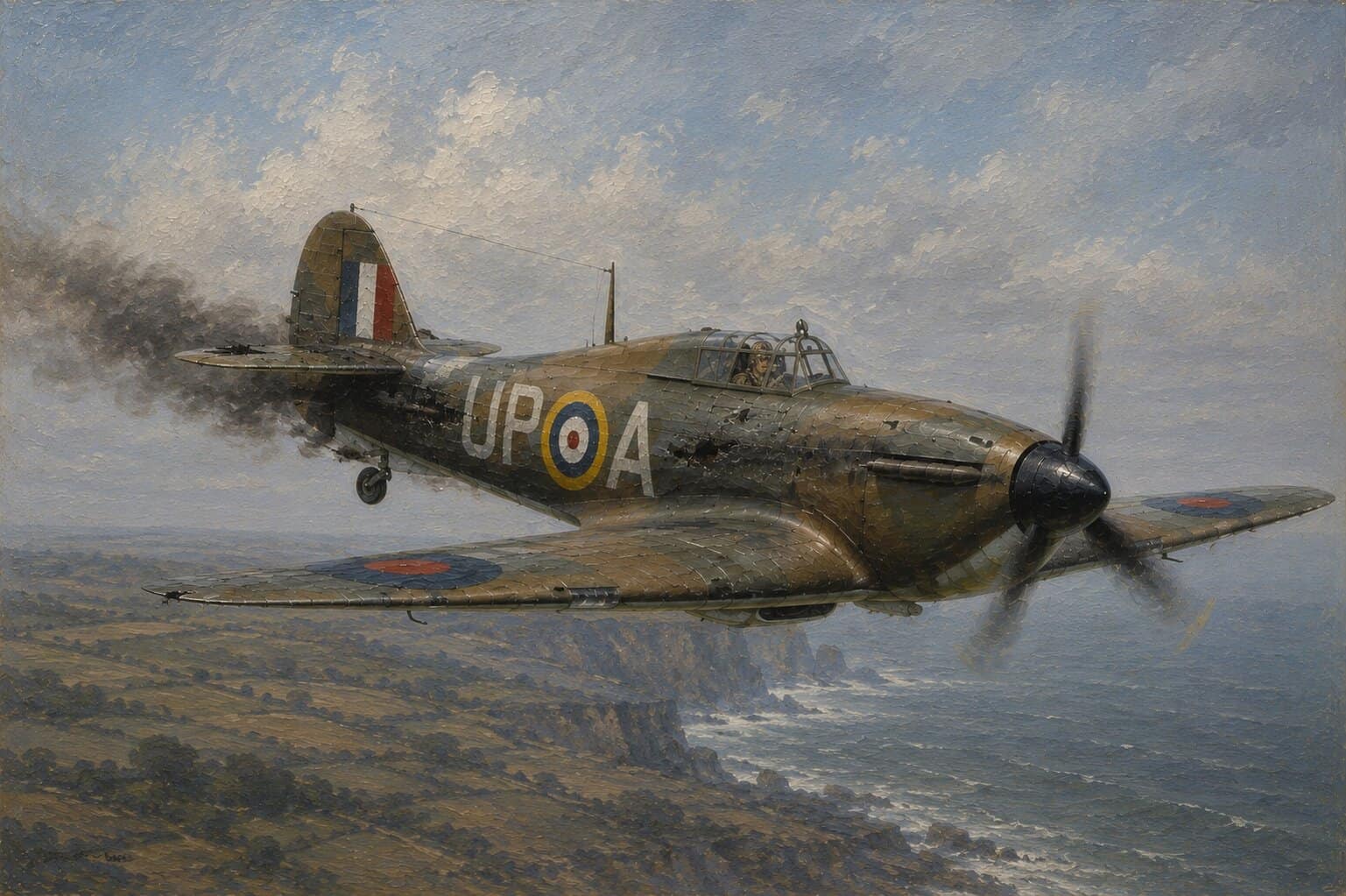
On 1 November 1940, Squadron Leader Archie McKellar was killed during a morning fighter patrol over Kent while commanding No. 605 Squadron. Taking off at 07:40, the formation patrolled near Faversham and encountered enemy fighters at high altitude. McKellar failed to return. His death came the day after 31 October, the date adopted by the Air Ministry as the official end of the Battle of Britain.
That boundary gave his loss a particular place in the campaign’s remembrance. Because McKellar died on 1 November, he fell outside the official dates used for the Battle of Britain Roll of Honour, despite having fought throughout the campaign. Fighter Command‘s operations against the Luftwaffe continued into November, and the morning’s patrol belonged to the continuing defence of southern England.
From Glasgow’s auxiliaries to wartime combat
McKellar’s route into the RAF began with civilian flying in Scotland. Born in Paisley, he learned to fly at the Scottish Flying Club at Abbotsinch and joined No. 602 (City of Glasgow) Squadron in 1936. The Auxiliary Air Force brought together men whose pre-war flying and training were combined with civilian occupations. Mobilisation turned that part-time commitment into wartime service.
With 602 Squadron, McKellar took part in the early fighting over Scotland in 1939. These interceptions brought auxiliary fighter units into action during the opening months of the war, defending the approaches to important naval and industrial areas. On 28 October, he helped bring down a German bomber which crashed in the Lammermuir Hills, an early success in the defence of Britain.
His service connected those Scottish encounters with the larger fighter campaign over southern England the following year. Experience acquired during the early interceptions accompanied him into a period of sustained combat and increasing responsibility.
Command of 605 Squadron
After transferring to 605 Squadron, McKellar took command during the Battle of Britain. Flying the Hawker Hurricane, he became one of the campaign’s prominent fighter pilots, with a reputation for leadership, courage and tactical skill. His wartime decorations included the Distinguished Flying Cross and a Bar, recognising his combat leadership in 1940. Following his death, he was also awarded the Distinguished Service Order.
On 7 October 1940, McKellar was credited with destroying five Messerschmitt Bf 109 fighters in one day, four in an early-afternoon engagement and a fifth later that afternoon. Such credits formed part of the wartime assessment of aerial combat, compiled from pilots’ claims and supporting evidence. His record established his standing within Fighter Command, alongside the responsibility of leading other pilots into action.
Squadron command combined combat leadership with the continuing demands of an operational unit. McKellar’s final patrol placed him once again in the air with his squadron, carrying out the fighter defence task that had shaped his wartime career.
The patrol of 1 November
The morning encounter near Faversham cost 605 Squadron its commanding officer. The formation’s meeting with enemy fighters at altitude and McKellar’s failure to return marked the end of a combat career stretching from Scotland’s early interceptions to the autumn fighting over Kent.
For the squadron, the immediate consequence was the loss of an experienced leader. For the wider history of the Battle of Britain, his death also exposed the difference between a campaign’s commemorative dates and the continuing sequence of operations experienced by its aircrew.
The official endpoint of 31 October provides a defined framework for the battle’s history and remembrance. McKellar’s loss on the following morning belongs to the same sustained air defence effort. November began with Fighter Command still flying patrols, engaging enemy aircraft and losing pilots who had helped defend Britain through the summer and autumn.