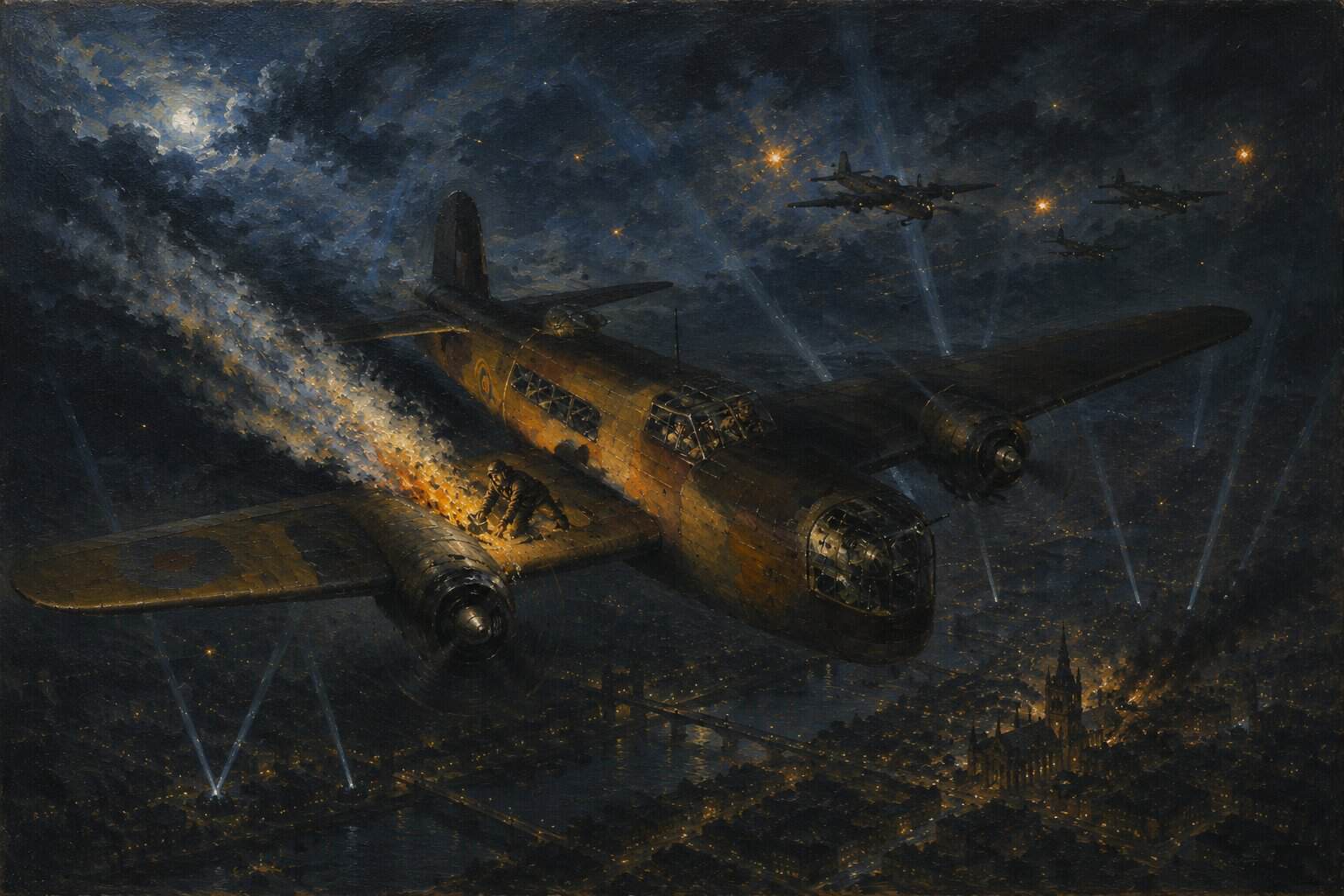
On 8 July 1941, Sergeant James Allen Ward of No. 75 Squadron was awarded the Victoria Cross after an astonishing act of courage in the air. Returning from operations over Germany the previous night, the Wellington in which he was serving was attacked by a German night fighter. The attack set fire to the starboard wing, creating a crisis that threatened the aircraft and everyone aboard it. Ward’s response became one of the most remarkable individual actions in RAF bomber history.
The action in the air
With the aircraft still in flight, Ward volunteered to go outside and deal with the fire. There was no simple way to do this. He climbed out through the astrodome and made his way onto the wing while exposed to the full force of the slipstream. Using only a rope for security and carrying a canvas cover, he edged along the wing of the Wellington towards the flames.
The difficulty of that act is hard to overstate. The bomber was moving at speed in darkness, and Ward was effectively standing in a hurricane of freezing air above a hostile coastline. He reached the fire and beat at it with the canvas cover, managing to smother the flames. He then pushed the cover into the damaged area to block the escaping fuel that had fed the blaze. Exhausted, he made his way back inside the aircraft.
His action did not repair the Wellington, but it removed the immediate danger of the fire spreading and gave the crew a chance to bring the aircraft home. That was the essential point. Ward’s courage converted what could have become a catastrophe into a survivable emergency.
Recognition and meaning
The award of the Victoria Cross recognised more than bravery in a general sense. It recognised initiative, cool judgement and physical determination under conditions in which one slip would almost certainly have been fatal. Ward acted while fully aware of the danger and with no certainty that success was even possible.
His award also carried wider resonance across the RAF and the wider Commonwealth. Ward was a New Zealander serving in an RAF squadron closely associated with New Zealand personnel, and his VC became the first of the war to be awarded to a New Zealand airman. In the summer of 1941, when Bomber Command was sustaining heavy losses and the outcome of the war remained far from certain, such examples of gallantry mattered deeply to morale.
The larger bomber war
Ward’s exploit also illustrates the nature of Bomber Command operations in the early war years. Crews faced risk not only over the target but throughout the whole sortie: enemy fighters, flak, fire, fuel leaks, navigation difficulties and the constant possibility that a damaged aircraft might never reach home. Survival often depended on the combined steadiness of a crew and, occasionally, on a single individual prepared to do the extraordinary.
James Allen Ward did exactly that. His courage did not arise from drama after the fact; it was exercised in the middle of danger, in darkness, on the wing of a burning bomber. For that reason, his Victoria Cross remains one of the RAF’s clearest examples of selfless bravery in action, and 8 July 1941 remains an enduring date in the Service’s history of gallantry.